Veneto, Italy
Via Follo, 33
31020 S. Stefano di Valdobbiadene (TV)
Italy
+39 0423 900138
Everything you need to know about Bisol, in Conegliano, Veneto.
The Bisol estate is located in Veneto, in the heart of the Valdobbiadene di Prosecco appellation. Twenty-one generations have presided over the destiny of this flagship estate, which spans 177 hectares of vineyards organized into 35 plots, stretching from Valdobbiadene to Conegliano: the most prestigious area of the appellation. Producers of Prosecco for centuries, the Bisol family also owns 3 hectares in Cartizze, the region's only cru: a monopoly. Cartizze is the estate's flagship, renowned for its very expensive hillsides, located at an altitude of 300 meters.
Although there are records of the Bisol family producing wine in the Prosecco appellation since 1542, it was not until 1875 that the Bisol estate, strictly speaking, came into being on the initiative of Eliseo Bisol. His son Desiderio gave it a new lease of life in the 1920s, in the aftermath of the First World War – when the land surrounding the appellation was the scene of clashes between Italian and Austro-Hungarian soldiers – and helped it through the Second World War. These trials and tribulations strengthened the estate's position as a leader in Prosecco and the region. The brothers Antonio and Eliseo Bisol, sons of Desiderio Bisol, now share the management of the company with their four children.
Long criticized by consumers for its poor quality (“unexpressive and overly acidic wine”), not to mention its apparent simplicity, Prosecco has gradually (and fortunately) earned its stripes, judging by the success of exports of this sparkling wine to countries such as Germany, the United Kingdom, and especially the United States. Bisol, like other producers in Valdobbiadene, is no stranger to this success. Indeed, the Bisol family gained worldwide notoriety thanks to the reputation of Prosecco and the widespread popularity of Italian cuisine in the late 1990s. This spumante (Italian term for sparkling wine) has the advantage of appealing to a wide range of tastes and being very easy to export. Fresh, light, and low in alcohol, it pairs beautifully with many different types of food and is therefore sure to please all palates, starting with those of young consumers of legal drinking age. For this generation, this sparkling wine is an excellent alternative (in terms of price and understanding) to champagne. Now high-quality and affordable, it is the ideal companion for all festive occasions with friends or at a restaurant. It must be said that this type of wine is quite unique, as it is made from a single vine and a grape variety native to the region: Glera (also known as Prosecco). The vines of this variety are trained using the pergola method, an old technic practiced by the Romans in ancient times, on steep slopes nestled in the hills.
Bisol selects the best plots to bring out the finest qualities of this grape variety. It should be noted that the estate also produces wines made from Pinot Blanc and Verdiso grapes. But among the 177 hectares of vineyards that make up the estate, the jewel in the Bisol family's crown is the fact that it is the proud owner of 3 hectares within the highly renowned Cartizze cru. This is in fact the only vineyard in the region with true cru status, making it highly sought-after and envied. To fully understand the importance of this part of the Prosecco vineyard, which is part of the Valdobbiadene Prosecco Superiore di Cartizze DOCG appellation, it is important to know that Cartizze covers 106 hectares divided among 140 different winegrowers. They are, so to speak, privileged, as one hectare of Cartizze costs no less than €2.5 million. By way of comparison, this is as expensive as a hectare in the prestigious Bordeaux appellations of Pomerol or Pauillac. The price of the land therefore reflects, without exaggeration, the intrinsic reputation of this beautifully exposed vineyard. The plot owned by the Bisol family, located on steep slopes anchored in the hills of the appellation at an altitude of 300 meters, belongs solely to the Bisols; in other words, it is like a Monopoly (according to the same principle as in Burgundy).
The Bisol estate therefore produces its sparkling wines mainly under the Prosecco DOC, Valdobbiadene Prosecco DOCG, Valdobbiadene Prosecco Superiore DOCG, Valdobbiadene Superiore di Cartizze DOCG, and Crede Valdobbiadene Prosecco Superiore DOCG appellations. Bisol also expresses its expertise, albeit more discreetly, in the Vino Rosso dei Colli Trevigliani IGT, Glera Metodo Classico, and Prosecco Frizzante DOC appellations, not to mention a few white and rosé Spumantes and a Passito outside the appellation.
The range is therefore very wide and extensive. With no fewer than 22 different types of wine, consumers who are passionate about spumante are unlikely to tire of the Bisol estate.
Sparkling wines, or Spumanti, are produced using the Charmat method. This type of vinification, which should not be confused with the traditional method, also known as the Champagne method, was first invented in Italy in 1895 before officially taking the name Charmat method in 1907 thanks to Jean-Eugène Charmat, an agricultural engineer from the University of Montpellier in France. Charmat improved on the Italian method and was the first to patent it in 1907. What does it involve? Well, it's very “simple.” The wines undergo fermentation in closed tanks, followed by a second fermentation in high-pressure tanks. This approach guarantees the final clarification of the bulk wine, resulting in a wine that is fruitier but perhaps more rustic than that produced using the traditional Champagne method. But this is the tradition in Veneto. However, although the Bisol family is firmly rooted in this strong tradition, it does not forget to be at the forefront of new technologies in order to take meticulous care in the production of its wines. Everything is controlled with metronomic precision. The result is wines of impeccable quality.
The Bisol estate excels in Brut, Dry, and Extra Dry Spumanti. The vintages in question go by the sweet names of “Crede” (a Brut in Valdobbiadene Prosecco Superiore DOCG), “Vigneti del Fol” (an Extra Dry in Valdobbiadene Prosecco Superiore DOCG), “Garnéi” “ (a Valdobbiadene Prosecco Superiore DOCG Brut), ‘Salis’ (a Dry, also a Valdobbiadene Prosecco Superiore DOCG), not to mention the pride of the estate, the ”Cartizze" cuvée (a Dry in the Valdobbiadene Superiore di Cartizze DOCG appellation). Furthermore, when the year is considered exceptional, Bisol does not forget to produce four vintage cuvées, this time using the traditional Champagne method. These wines, grouped under the name “Millesimati Talento Classic Method,” are known as “Eliseo Bisol cuvée del Fondatore” (in homage to the estate's founder), ‘Riserva’ (a Brut), “Pas dosé” (an Extra Brut), and a Rosé (Brut).
Completing the range, Jeio Selection includes “noSO2” wines (a spumante with no added sulfur), ‘Cartizze’ (Valdobbiadene Superiore di Cartizze DOCG), “Valdobbiadene Brut” (Valdobbiadene Prosecco Superiore DOCG), “Colmei,” “Foie” (in Prosecco Frizzante DOC), then three Spumante cuvées in Brut (one white, one rosé) and the “Cuvée Extra Dry” (a white Spumante). On the fringes of these wines but no less interesting are “BelStar” (in Prosecco DOC), probably ideal as a base for cocktails (mixology), not to mention the ‘Molena’ cuvées (a dry wine in the Valdobbiadene Prosecco DOCG), “Ceo” (a red wine in IGT Vino Rosso dei Colli Trevigliani), “Relio” (an Extra Brut Glera Metodo Classico) and “Duce di Dolle” (the famous Passito, a type of wine in which the Italians are masters, ideal for accompanying poultry and desserts).
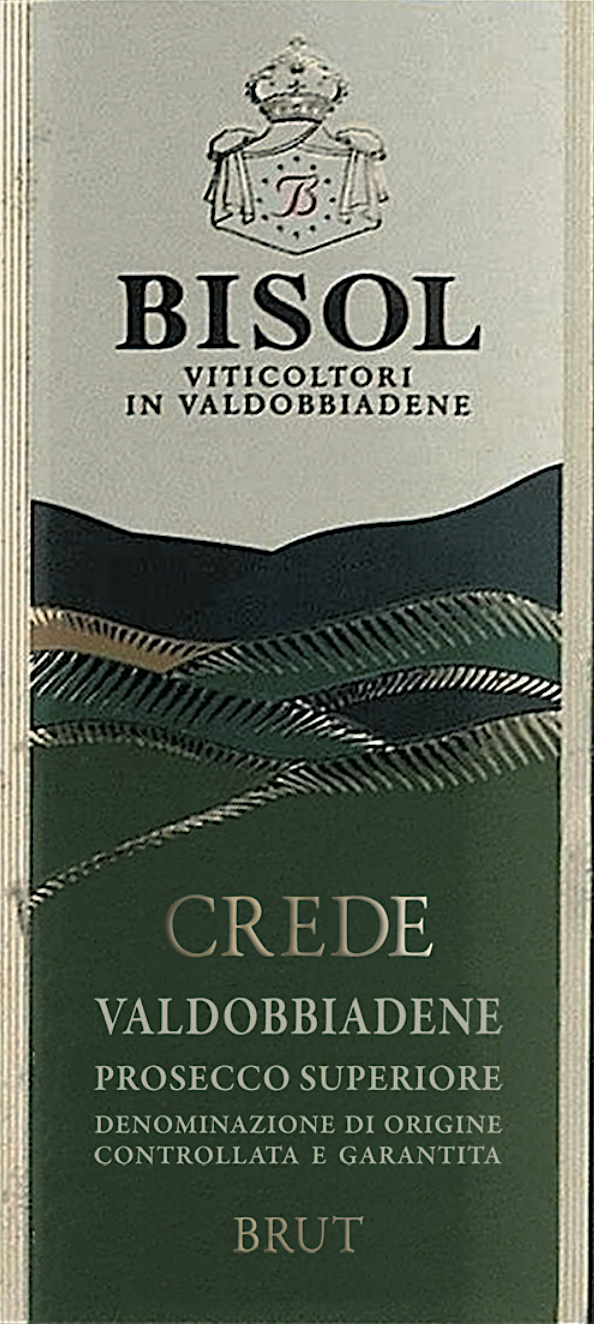
This is a blended Prosecco made from 85% Glera, 5% Verdiso, and 10% Pinot Blanc. It is a selection of lots whose grapes are grown on the very steep hillsides of the estate's vineyards. Glera and Verdiso grow on clay soil with a subsoil matrix of marine sandstone known locally as “creda,” hence the name of the cuvée. It should be noted that this soil type protects the vines from drought and heat waves, while bringing aromatic freshness to the grapes (and subsequently to the wines produced) thanks to the natural acidity provided by the altitude and soil type. The result is a highly aromatic and well-balanced Prosecco.
Crede de Bisol is a Prosecco Brut with a beautiful clear straw yellow color and green highlights typical of wines made from Glera or Prosecco grapes. The color is bright and clear straw yellow with green hues, accompanied by a beautiful mousse and a fairly fine string of bubbles. It has a frank and rich expression of white flowers and white-fleshed fruits. The palate is lively with a frank attack revealing a sensation of freshness and balance, not without elegance. The mid-palate, both lively and creamy, is persistent with expressions of golden apple and delicate flowers. The wine is sapid and refreshing without being basic: one sip leads to another.
The holy of holies. In the heart of Veneto, the Cartizze vineyard, covering 106 hectares divided between 140 different winegrowers (out of a total of 24,000 hectares in the Valdobbiadene vineyard), is a micro-vineyard with highly sought-after assets. Bisol owns 3 hectares there as a monopoly. This corner of the steep slopes of Cartizze, reaching an altitude of 300 meters, is considered a “corner of paradise” by Italian writer Adriano Màdaro, held in very high esteem by local producers and highly sought after by lovers of great Prosecco. It is a small area, a cru, which takes its name from Santo Stefano. The microclimate is very favorable for the full expression of the Glera grape variety due to the coolness and mildness of the location. It is the oldest part of the Valdobbiadene vineyard. The soil type (firm rock deep down mixed with crumbly stone on the surface) makes for very fine soil that never lacks water. This is therefore a major asset for the full development of the star grape variety (Glera), which ripens slowly and steadily in this area.
Bisol's “Cartizze” is a Valdobbiadene Superiore di Cartizze DOCG with a dry taste. The color is a beautiful, fairly light straw yellow, with a string of very fine, persistent bubbles. The nose reveals subtle aromas of yellow-fleshed fruits (orchard fruits), mirabelle plums, and yellow rose petals, with a sensation of absolute freshness and great mineral tension. The attack on the palate is precise and persistent, followed by a creamy mid-palate, quite full-bodied with some saline and mineral flavors. Lots of flavor, balance, richness, and freshness! Long finish with an intense fruity note! This is a Spumante of great style with a lot of class. In short, a connoisseur's Prosecco that is much more suited, due to its richness and density, to the table, and therefore to fine dining, rather than simply as an aperitif.
2006, 2012, 2013, 2014, 2016, 2020, 2021,2025