Saint-Estèphe, Bordeaux, France
33180 Saint-Estèphe
France
+33 (0)5 56 59 30 57
All about Cos d’Estournel wine estate, Second Classified Growth in 1855 on Saint-Estèphe appellation
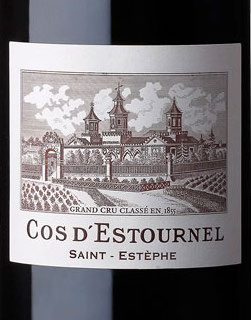
Located high at the beginning of the Saint-Estèphe appellation, in a place called Cos, Château Cos d'Estournel is a second growth classified in 1855, and one of the most atypical with its oriental-style architecture. This Maharajah's "palace", the wish of Marquis Louis Gaspard d'Estournel, nicknamed the "Maharajah of Saint-Estèphe", is in fact a cellar like no other. A property committed to excellence from the outset, Cos d'Estournel grew under the influence of the Marquis d'Estournel, the Ginestet family and merchants, and the Prats family, until it was bought out in 2000 by Michel Reybier, the jewel's current owner.
It's no secret that Cos d'Estournel has long cultivated a sense of difference. The estate, starting with the architecture of the main building - highly visible after passing Château Lafite-Rothschild - was created by a colorful character. Louis Gaspard d'Estournel, known as the Marquis de Saint-Estèphe, but above all as the "Maharajah of Saint-Estèphe". But why? Quite simply because of his pronounced taste for the Orient and wines "back from India". The result is a château (or, to be more precise, a winery) strongly influenced by the Orient, with pagodas at either end of the building.
In 1791, Louis Gaspard d'Estournel inherited an estate comprising 14 hectares of vines. Quickly convinced that this hillside was endowed with an exceptional terroir, the Marquis d'Estournel decided to spend a fortune expanding the vineyard. In 1852, he found himself at the head of 45 hectares of vines, spread over 3 crus: Cos d'Estournel, Cos Labory and Pomys. Louis Gaspard's quest for excellence drove him to perpetual technical improvement and innovation. He never hesitates to explore, test and experiment in his vineyards and winery. He tries out new grape varieties to better match the terroir. A versatile man, curious about everything and fundamentally open to the world, it was his passion for the Orient that led him to add an astonishing touch to the estate, sprinkling it with things from India and China. It was also at this time that he was the first to sell so-called "retour des Indes" wines, i.e. wines made from barrels that had made a round trip to Bombay or even Calcutta. Louis Gaspard d'Estournel travels the four corners of the globe in search of new commercial outlets, particularly, and most obviously, in the Far East. Renowned for their quality, Château Cos d'Estournel wines were exported across the seas, including to India from 1838.
However, the Marquis d'Estournel's financial commitment reached its limits. In 1852, ill and heavily in debt, he was forced to sell his properties to a London banker a man named Martyn. He finally died a few months later, just 2 years before the legitimization of his cru, which was consecrated Second Cru Classé in 1855. A well-deserved rank in view of the considerable efforts of its charismatic owner, whose audacity, quest for perfection and sense of architectural spectacle would be remembered centuries later.
The estate subsequently changed hands four times. Cos d'Estournel belonged to Spanish aristocrats Errazu, the Hostein brothers, Fernand Ginestet (the wine merchant), the Merlaut family and Jean Prats, before becoming the property of entrepreneur Michel Reybier in 2000. Since his purchase, Michel Reybier, like the Marquis de Saint-Estèphe long before him, has continued to pursue the philosophy of Louis Gaspard d'Estournel. Always forging ahead, while staying one step ahead in terms of techniques and knowledge of the vineyards, in the pursuit of excellence.
Paragraphe 3
Michel Reybier wanted Cos at any price. If he hadn't got it, he wouldn't have invested elsewhere in Bordeaux. Understandably, this château and its wines are bewitching in many ways. So, as soon as Michel Reybier arrived at the head of the estate, it was decided to rethink the technical side of the business to improve vinification, to create a "cousu-main" approach with parcel-by-parcel vinification in phase with the nuances of the parcels, which react differently according to the grapes they bear, the orientation of the vines and the pedological profile (soil and subsoil) of the plots. The main building - topped by pagodas - was completely renovated. Michel Reybier decided to build a new vat room and cellar, the only ones of their kind in the world, entirely gravity-fed, all separated by a transparent walkway made of glass tiles. It's elegant without being ostentatious. The vat room was also redesigned, with 72 truncated-cone stainless-steel vats for meticulous, parcel-by-parcel vinification, with the utmost respect for the product, all equipped with elevators to ensure that gravity is respected throughout the entire process; elevators for raising and lowering the cuvons, the small vats on wheels that transport the grapes - the caviar, so to speak.
Cos d'Estournel extends over nearly 100 hectares (91 hectares in fact) of hillside vineyards. Located to the south of the Saint Estèphe appellation, in the north of the Médoc, château Cos d'Estournel boasts a prime vineyard. Separated by the Jalle du Breuil stream, which runs alongside the vines of château Lafite Rothschild, Cos d'Estournel is dominated by deep gravel. Which reminds us that Cos means "hill of pebbles" in old Gascon. The name of the château, as well as that of the locality, was therefore apt and fully justified.
The average age of the vines is around 45 years, with a few old vines reaching 80 years. It is precisely these vines, at least 20 years old, that will be used to blend the grand vin, château Cos d'Estournel. Here, the thin gravel of the summits and the southern slopes are home to Cabernet Sauvignon (60% of the vineyard) and Petit Verdot, which find their preferred soils in these gravelly areas. Conversely, on the eastern slopes and hillsides, Saint-Estèphe's limestone bedrock outcrops (as it does in Saint-Emilion), providing an ideal location for Merlot (40% of the vineyard) and Cabernet Franc. The central part is anchored on a plateau of deep gravel. On the sides are two slopes, on deep gravel and clay soils. One faces east, the other south.
In 2001, Michel Reybier decided to commission a study at the vineyard to map the soils and better understand the mosaic of the vineyard. The study revealed nearly 20 different soil types. This richness and patchwork of soils provides a wealth of opportunities to refine the Cos d'Estournel style and guarantee the harvest of perfectly ripe grapes, depending on the plot. Another advantage is the vineyard's proximity to the Gironde Estuary and the Atlantic Ocean. The wind sweeping across the terroir purifies the air and helps combat excess humidity, keeping the vines in good health - a sine qua non for producing great, pure wines. This topographical proximity also provides a maritime climate, limiting excess weather. These exceptional conditions ensure optimum ripeness of the grapes, preserving their aromatic freshness and complexity. To guarantee the style of the estate's wines over the very long term, while ensuring the heritage of future plantings, Michel Reybier and his teams rely on massal selection. They are committed to a perpetual quest for precision and excellence. This is the price to pay for the greatness of Cos d'Estournel wines.
It's important to emphasize that one of the team's concerns is to manage the vines and produce wine in the most natural and ecological way possible. With High Environmental Value certification, the estate is committed to preserving and respecting nature and the environment in everything it does.
Cos d'Estournel has been famous for over a century for its Grand Vin, château Cos d'Estournel. It is made from vines with an average age of 55 years. Cos d'Estournel red is seductive, opulent and finely chiseled, with aromas that are often spicy. The wine is always well-balanced, with silky tannins and a long, long finish. A wine of great class and ageing potential. Like other Médoc grands crus, Cos also offers a dry white, Cos d'Estournel Blanc, a blend of Sauvignon Blanc and Sémillon. It's one of the Médoc's dry whites that counts for its subtlety, liveliness and elegance. A Bordeaux white wine appellation, it offers a generous, complex aromatic bouquet of apple, lemon, mango and white peach. Since 1994, château Cos d'Estournel has also produced a Second Vin: Les Pagodes de Cos. Made from 35-year-old vines, this second wine gains in excellence and precision every year. Charming by definition, the wine is no less dazzling and delicate on the palate. The second wine is also available as a dry white. Last but not least, in 2003, Cos d'Estournel launched a wine designed to charm and be highly drinkable, more accessible, more focused on pleasure, fruit and tannic structure. Mission accomplished with "G" de Cos d'Estournel, or rather Goulée by Cos d'Estournel.
The wine has great depth, straightforwardness and vibrancy. Made from 74% Cabernet Sauvignon, 23% Merlot, 2% Petit Verdot and 1% Cabernet Franc, Cos d'Estournel 2018 is a wine of character. Powerful, dense nose of black fruit with a very pure expression and lots of freshness, all mixed with spicy notes (very Cos d'Estournel). In this great vintage, the wine is powerful with great balance. On the palate, the weight of the wine is substantial, with dense tannins, great nobility and beautiful maturity on the mid-palate. Undoubtedly, a Cos d'Estournel of great ageing potential that will need to be waited for to appreciate all its depth and subtlety.
Cos d'Estournel's second wine, produced since 1994, is made from vines over 20 years old. The blend (60% Merlot, 36% Cabernet Sauvignon, 3% Cabernet Franc and 1% Petit Verdot) demonstrates, in this very Bordeaux vintage, the immense progress achieved since the plot-based policy begun in 2001 and the technical innovations introduced in the mid-2000s. The nose is pure, with an aromatic expression that is both floral (mint) and very black-fruited (blackberry and black cherry). It's greedy without lacking character. The palate is dynamic, with a creamy, refreshing tannic structure. This wine can be kept for 15 years, but can be enjoyed after 6 years in bottle.
This great dry white made in Saint-Estèphe, made up of 93% Sauvignon Blanc and 7% Sémillon, offers a concert of floral and citrus aromas with directness and plenty of freshness. Les Pagode de Cos blanc 2018 is a greedy, mineral, intense and lively wine with exquisite aromatic depth and great uprightness on the palate.
La Goulée was launched for the 2003 vintage and quickly became a wine that fulfilled all its promises. From 2019, the wine will be renamed G d'Estournel. Made from 86% Merlot, 13% Cabernet Sauvignon and 1% Cabernet Franc, the wine offers richness and freshness with a disconcerting balance of precision and energy. Lively and peppery, G d'Estournel is long and silky, with aromas of blackcurrant and eucalyptus, followed by garrigue notes of thyme and rosemary. It's a straightforward, no-nonsense wine that gets straight to the point with the pleasure it gives. A great success.
1928-1929-1945-1947-1949-1953-1955-1959-1961-1970-1975-1978-1981-1982-1983-1985-1986-1988-1989-1990-1996-2000-2003-2005-2009-2010-2015-2016-2018-2019-2020-2022