Nuits-Saint-Georges, Burgundy , France
8, rue du Tribourg
21700 Nuits-Saint-Georges
France
+33 3 80 61 04 55
Find out more about Domaine Faiveley, located in Nuits-Saint-Georges in Burgundy's Côte de Nuits region.
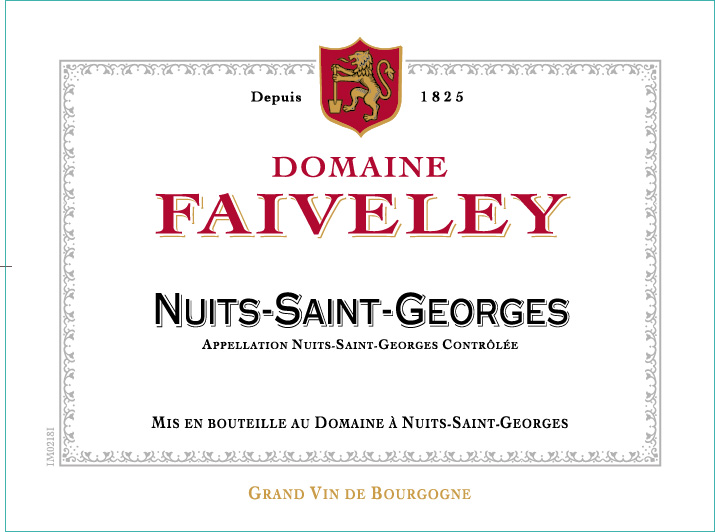
Domaine Faiveley is located on the Côte de Nuits, in the village of Nuits-Saint-Georges. Since 1825, the Faiveley family has owned over 120 ha of vines (all converted to organic farming) on exceptional terroirs, including 12 Grands Crus and 25 Premiers Crus. This highly respected family has always worked the vines, respecting and serving the climates of the Côte de Nuits, Côte de Beaune and Côte Chalonnaise. Today, representing the 7th generation, Erwan Faiveley and his sister Eve continue to write the finest pages of Faiveley, producer and négociant-éléveur, serving Burgundy's greatest terroirs in a style combining power, finesse and elegance.
Domaine Faiveley was founded in Nuits-Saint-Georges in 1825 by Pierre Faiveley, a lover of Burgundy terroirs, who initially focused on the production of Côte de Nuits wines, but also wished to set up his own trading company. Pierre Faiveley is a former artisan shoemaker, and so was not born a winegrower-merchant; a unique fact, to be sure, and a common denominator in each subsequent generation, who first practiced another trade or a parallel trade before joining the family domain and wine merchant business.
In 1860, Joseph Faiveley, François Faiveley's nephew, took over the reins of the Faiveley estate until his death in 1923. During his tenure, he developed the business by exporting wines to Northern Europe, and in 1864 acquired a 3-hectare parcel that would become a milestone in the Faiveley family's own holdings: the famous Corton Clos des Cortons Faiveley (integrated with the Le Rognet and Corton localities).
In 1889, François Faiveley took over the family business. At this time, the business experienced difficulties as the phylloxera crisis ravaged all European vineyards, and Burgundy was no exception.
The family business reached a turning point in the 20s with the arrival of his son Georges Faiveley.
Georges Faiveley is probably the generation that will leave its mark on the company, to the point of positively shaking up the economy of Côte de Nuits wines, and perhaps even Burgundy wines in general. Indeed, under his management of the family business, he, like everyone else, suffered the economic crisis of 1929, the Wall Street crash that shook the entire world economy for decades. From then on, wine stocks piled up in cellars and at wine merchants', and could no longer be sold. Indeed, what can you do in such a situation, when drinking wine becomes an expensive pleasure and much less essential to everyday life? With orders in the company's European markets slowing to a trickle, Georges Faiveley came up with an incredible idea, inspired by a trip to Paris in 1934. The anecdote is significant. The year was 1934. While strolling through the bookshops on the banks of the Seine, Georges Faiveley came across a book on bacchanalian brotherhoods. Curious and interested in the subject, he bought the book. Returning home to Burgundy, Georges discussed the book with his good friend Camille Rodier. It was at this point that he realized that he could share his wines simply and generously around a table with all Burgundy lovers. His stroke of genius: to found a wine brotherhood. The Confrérie des Chevaliers du Tastevin was born. The Confrérie des Chevaliers du Tastevin, a resurgence of ancient oenophilic brotherhoods, still carries Burgundy's strong values around the world today.
With this initiative, Georges Faiveley brought about a revival in Burgundy and, of course, in wine consumption, all associated with the strong values of sharing and friendship. A year earlier, Georges took the opportunity to extend the company's field of action by signing a lease for land and parcels in the Côte Chalonnaise region, which were subsequently purchased by his son, Guy Faiveley. The creation of this famous brotherhood was therefore a major boost for Domaine Faiveley, enabling it to experience an economic revival while acquiring new plots and vinifying in new appellations, thus increasing the range offered by the Faiveley wine merchant.
His son François, representing the 6th generation, joined the company at the age of 25, in 1976. The company also owes its expansion to him, integrating new plots in new appellations.
While Faiveley's history has traditionally been handed down from father to son, Erwan Faiveley, the 7th generation of the Faiveley family, is introducing a new development in the company's history. Arriving in 2005, he took over the reins of the estate and the company, assuming the role of Managing Director, while modernizing the infrastructures, starting with the winemaking facilities (renovation of the Mercurey cuverie, then, in 2018, of the magnificent Eiffel-style cuverie in Nuits-Saint-Georges), while also expanding into other appellations (acquisition of parcels in 2008 in the white Grands Crus of Bâtard-Montrachet and Bienvenue-Bâtard-Montrachet) and making his first foray into the American vineyard, in California, with a stake in William Selyem. The new development we've been talking about is the arrival of a woman in the company's destiny: Eve Faiveley. Erwan's sister, Eve joined her brother in 2014 to jointly manage the company. Initially in charge of communications and marketing, Eve now looks after the sales network on the French market and some export zones. This close-knit duo brings an additional breath of fresh air to the history and development of the Faiveley estate, while continuing to serve the tradition and know-how borne valiantly and brilliantly by their predecessors. With the firm intention of ensuring the company's longevity, while carrying out new projects and “modernizing” the style of the wines (perhaps more in line with the expectations of consumers looking for Burgundies that are more expressive and drinkable in their prime, without robbing them of their ability to age and improve), Erwan and Eve are indeed the worthy successors of their forefathers.
Domaine Faiveley is currently the largest winegrowing estate in the Côte d'Or, with around 160 hectares of vines and 300 distinctive plots. Its vineyards are located in renowned climates and appellations in Côte de Nuits (its historic stronghold), Côte de Beaune, Chablis (with the 2014 acquisition of Billaud-Simon) and Côte Chalonnaise. The historic center of Nuits-Saint-Georges, the villages of Gevrey-Chambertin, Pommard, Volnay,Puligny-Montrachet and Mercurey all fall within its sphere of influence.
Domaine Faiveley has built its reputation on Grands Crus (10 hectares) and Premiers Crus (around 30 hectares) in Gevrey-Chambertin, Chambolle-Musigny, Clos de Vougeot, Corton and Nuits-Saint-Georges, as well as three Monopoles: Gevrey-Chambertin Premier Cru Clos des Issarts, Corton Clos des Cortons Faiveley Grand Cru and Beaune Premier Cru Clos de l'Ecu. Faiveley is also present in Corton-Charlemagne - in short, in all the major Burgundy appellations.
To vinify all these marvels and manage such a wide range of viticultural situations and appellations (and wines), Domaine Faiveley has two wineries, enabling it to plan harvest arrivals according to the geographical sectors concerned, so as to be able to carry out parcel-by-parcel vinification.
Faiveley can count on its teams, led since 2007 by the company's Technical Director, Jérôme Flous, and on two state-of-the-art wineries capable of managing grapes and wines according to the hierarchy and level of zones and quality. One is in Nuits-Saint-Georges and the other in Mercurey on the Côte Chalonnaise. The Mercurey winery, inaugurated in 2015, is used to vinify parcels in Mercurey, Maranges, Givry and Rully. As for the other cuverie in Côte de Nuits, it is used primarily to vinify and mature Grands Crus from Côte de Beaune and Côte de Nuits. This winery was renovated in 2018 and, like the Mercurey winery, is equipped with all gravity and thermoregulation systems, and boasts a splendid Eiffel-style frame. It's worth remembering that the famous French architect who designed the Eiffel Tower, among other things, was a Burgundian, coming from the town of Dijon. This cutting-edge equipment has contributed, under the influence of management's willingness to explore other avenues, to modifying the style of our house wines, which used to be more massive, more concentrated and more geared to ageing, but have now become more gourmet, more accessible in their early years, although this does not prevent us, depending on the vintage, from offering wines for ageing, particularly in the Grands Crus and Premiers Crus.
The wines produced from Faiveley's 300 vineyard parcels have a common denominator, so to speak, at least since 2007: wines that are more precise, fine, gourmet, with purity of fruit and easier to appreciate when young. But more than that, they are the result of viticulture that is more in line with the environmental objectives set by Erwan Faiveley and his teams. In fact, since July 2022, the entire Faiveley estate has gone over to organic viticulture (the vines will be AB certified in 2025), the fruit of a long process of reflection that is not simply motivated by ever-increasing consumer demand for organic wines, but by conviction. Indeed, at the Faiveley estate, as at many others in Burgundy, the use of chemicals in conventional viticulture quickly showed its limitations. The Domaine Faiveley had already taken a step forward by adopting a “lutte raisonnée” approach with Erwan and Eve's father, François Faiveley. But the children went even further, deciding to convert 120 hectares (the entire estate) to organic farming, making Faiveley the first estate in terms of surface area to go organic. Today, one third of the estate is farmed organically, while the remaining two thirds are HVE 3 certified.
To get the full measure of Faiveley's style, the choice of wines is vast, even among the Grands Crus and Premiers Crus. Let's talk about the emblematic wines (of which there are many) or the exclusivities or in-house “Monopoles”. How could we not mention a rarity, the Grand Cru Corton Clos des Cortons Faiveley Monopole in Côte de Beaune (the only red Grand Cru in Côte de Beaune), or even the Grand Cru Chambertin-Clos de Bèze “Les Ouvrées Rodin” in Côte de Nuits, or further south, in Côte Chalonnaise, the Premier Cru Mercurey Clos des Myglands Monopole, or in Village, the MercureyClos Rochette Monopole and its neighbor, the Mercurey La Framboisière Monopole.
This 2.76-hectare parcel, acquired in 1874 by the Faiveley family, is emblematic and its wine is the flagship of Maison Faiveley as a winegrowing estate. The wine's style owes much to Corton's soil diversity: more chalky on the higher ground (a 300-meter-high hill), more ferruginous with heavier red earth on the lower ground. The result is a wine that is straightforward, mineral, powerful yet elegant, fine and deep. The nose displays rich, intense aromas of red fruits mixed with spices. The palate is reasonably serene and well-balanced. A great Corton and a wine for laying down par excellence.
A neighbor of the Clos Rochette parcel, Faiveley's other Monopole in Mercurey Village, Mercurey La Framboisière Monopole is an 11-hectare 11 parcel purchased in 1933. Why “La Framboisière”? Quite simply because of the presence of raspberry plants on the site. The nose is highly aromatic, with intense notes of forest fruits and red fruits, including raspberries. The palate is greedy and fruity, with smooth tannins. A gourmet wine and a perfect image of the best of the Côte Chalonnaise.
1947, 1959, 1961, 1964, 1966, 1969, 1971, 1976, 1978, 1985, 1986, 1989, 1990, 1993, 1995, 1996, 1997, 1998, 1999, 2002, 2003, 2005, 2007, 2009, 2010, 2014, 2015, 2016, 2017, 2018, 2019, 2020, 2021, 2022,