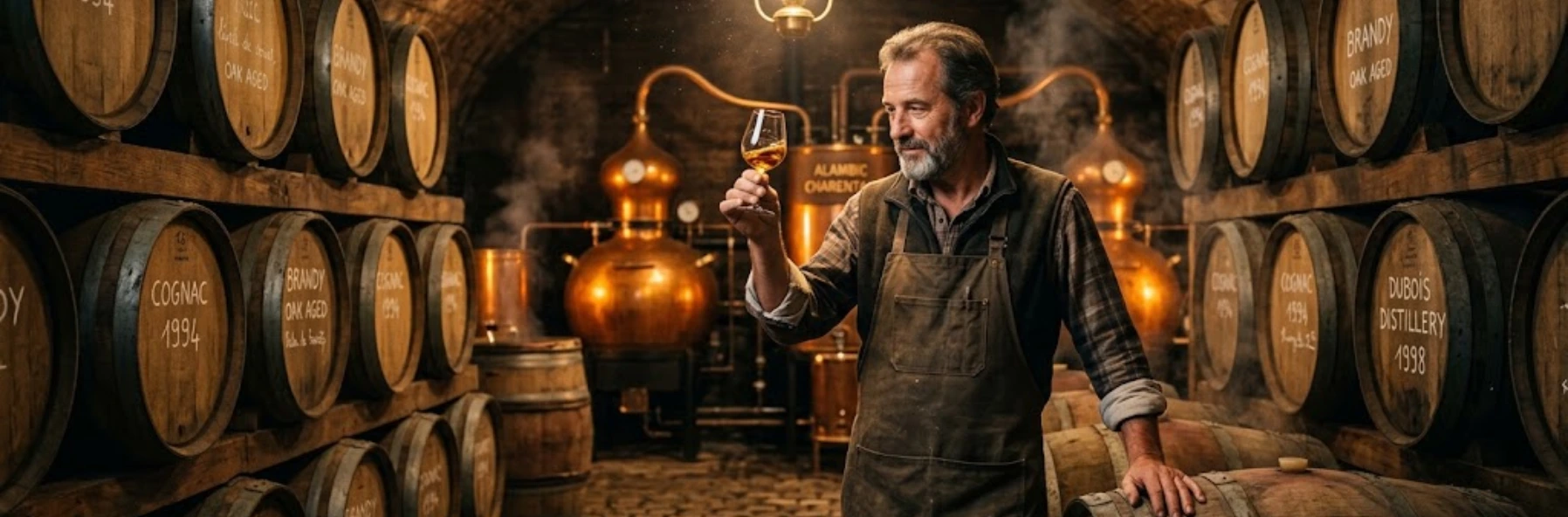
A Brandy producer is a distiller specialising in the elaboration of brandy, a generic term for any spirit produced by distilling wine or fermented fruit juice. Unlike Cognac and Armagnac, which benefit from strictly French appellations d'origine contrôlées, brandy is an international category produced on every continent, with traditions and methods unique to each producing country.
Brandy encompasses an extraordinarily diverse family of spirits: from Spanish Brandy de Jerez with its notes of dried fruit and caramel, to Armenian Brandy with its dried fruit and spice aromas, to the brandies of Latin America, the Philippines or South Africa. Each expresses the terroir, grape varieties and distilling know-how of its region of origin.
Brandy is one of the oldest spirits in the world. Its history is intimately linked to that of distillation, introduced to Europe in the Middle Ages by Arab alchemists and monastic physicians. As early as the 15th century, Dutch merchants were distilling Spanish wines to facilitate sea transport, giving birth to brandewijn (burnt wine) which would become brandy.
It is Spain that developed the most structured brandy tradition outside France, with Brandy de Jerez, elaborated in the Sherry region using the solera ageing system, and recognised as a geographical indication since 1987. Armenia also has a very old tradition with Ararat Brandy, whose worldwide reputation dates back to the late 19th century.
In the 20th century, countries such as the Philippines, India, Mexico and South Africa developed their own brandy industries, often at considerable volumes. Today, brandy is one of the most consumed spirits in the world, particularly in India and South-East Asian countries.
Brandy production varies considerably between countries and traditions. In all cases, it begins with the selection and vinification of grapes or other fruits, then distillation in a pot still (batch) or column still (continuous), depending on the style sought. Pot stills produce richer, more aromatic brandies, while columns produce lighter, more neutral spirits.
Ageing in oak casks is a key step in most premium brandies. The solera system, used notably in Jerez, involves ageing brandy in stacked rows of casks where young spirits are progressively blended with older ones, creating a remarkable continuity of style.
Blending is finally the art of the cellar master: they select and blend different spirits of varying ages and origins to create the final aromatic profile of the cuvée, guaranteeing the consistency and character unique to each house.
According to data from the IWSR (International Wine and Spirits Research):
Over 700 million bottles of brandy sold worldwide each year — IWSR
India is the world's largest brandy market by volume — IWSR
The Philippines are home to the world's best-selling brandy brand: Emperador — IWSR
Brandy de Jerez represents approximately 40 million bottles per year — Consejo Regulador
Armenia exports its brandy to over 50 countries — Armenian Brandy Association
Brandy de Jerez — Spain, solera ageing, notes of dried fruit, caramel, wood
Armenian Brandy — Armenia, local grape varieties, pot still, fruity and spicy aromas
Georgian Brandy — Georgia, Caucasian tradition, oak cask ageing
Pisco — Peru and Chile, unaged grape spirit, disputed GI between the two countries
Philippine Brandy — colossal volumes, light and accessible style, huge domestic market
Indian Brandy — world's largest volume, often made from molasses, domestic market of hundreds of millions of cases
South African Brandy — strict regulations, minimum 30% pot still, internationally recognised quality
American Brandy — mainly California, local grape varieties, varied style
Mexican Brandy — significant production, style influenced by Spanish traditions
Greek Brandy — Metaxa, unique style blending brandy and muscat wines, very popular in Southern Europe
Brandy is experiencing a spectacular quality revival in many regions. Artisan producers in Spain, California, South Africa and Armenia are crafting premium brandies that rival the great Cognac houses. This craft movement is accompanied by increased attention to terroir, local grape varieties and traditional distillation methods.
The rediscovery of Pisco from Peru and Chile by international bartenders illustrates this trend well. This unaged brandy, with its fresh grape and floral aromas, has become an essential ingredient on the global cocktail scene.
Finally, the premiumisation of Asian brandies, particularly in India and the Philippines, reflects a profound evolution of the global market, with increasingly demanding consumers focused on quality and authenticity.
González Byass – Lepanto — Jerez, Spain
Osborne — El Puerto de Santa María, Spain
Torres – Miguel Torres Brandy — Penedès, Spain
Lustau — Jerez, Spain
Ararat — Yerevan, Armenia
Noy — Yerevan, Armenia
Emperador — Manila, Philippines
Fundador — Jerez, Spain
Cardenal Mendoza — Jerez, Spain
Brandy 103 — Jerez, Spain
Veterano – Osborne — Jerez, Spain
Van Ryn's — Stellenbosch, South Africa
Klipdrift — Robertson, South Africa
Pisco Portón — Ica, Peru
Casa del Pisco — Santiago, Chile
Paul Masson — California, USA
Korbel — California, USA
Metaxa — Athens, Greece
Sang Som — Bangkok, Thailand
Alexander — Tbilisi, Georgia
Cap Breton — Western Cape, South Africa
KV Wines – Kindzmarauli — Kakheti, Georgia
McDowell's No.1 — Bangalore, India
Bodegas Rubio — Jerez, Spain
Proshyan Brandy Factory — Yerevan, Armenia
Vinicola Internacional — Mexico City, Mexico
Would you like your company to appear on this page? Listings are reserved for Pro Premium members of Wine BHM.
Join the selection of producers on the platform.
Join the network*Featured listings are reserved for Pro Premium members, subject to terms and conditions.