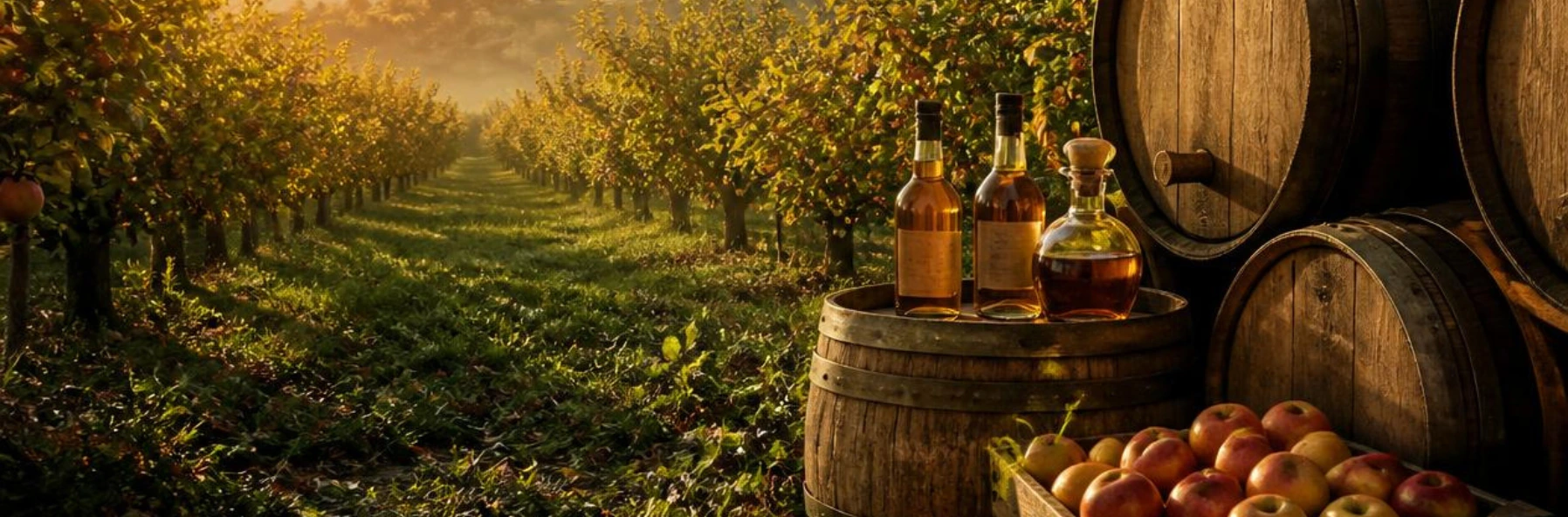
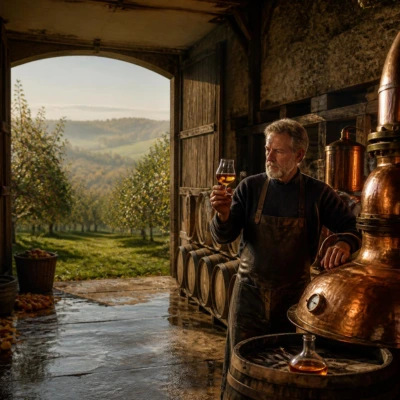
A Calvados producer is a craftsman distiller specialising in the elaboration of Calvados, an apple and pear brandy benefiting from a strictly delimited Appellation d'Origine Contrôlée (AOC) in Normandy, France. It is the only major French spirit made not from grapes but from apples and pears, which gives it a unique personality in the world of brandies.
A Calvados producer is often simultaneously an orchardist, cider maker and distiller. They manage their orchards of cider apple and pear trees, ferment the fruit into cider or perry, then distil and age the spirit in oak casks. It is a profession deeply rooted in the Norman terroirs, passed down through generations in many families.
The distillation of cider in Normandy dates back to the 16th century. The first written mention of Calvados dates from 1553, in the journal of Gilles de Gouberville, a Norman gentleman who describes distilling cider on his land. For centuries, every Norman farm had its own still and produced a spirit for personal consumption.
It was paradoxically World War One that gave Calvados its international fame. Allied soldiers stationed in Normandy discovered and appreciated this local spirit, contributing to its reputation beyond French borders.
The first Calvados AOCs were created in 1942, delimiting the production zones and authorised methods. Today, Calvados is experiencing a spectacular revival, driven by a new generation of producers focused on quality, organic farming and exports to Asian and American markets.
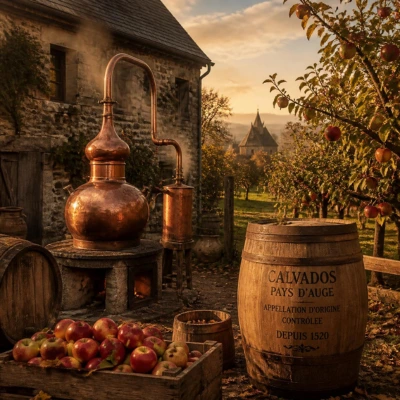
Calvados production begins in the Norman orchards, where hundreds of varieties of cider apples and pears grow, classified as bitter, bittersweet, sweet and acidic. The blending of these varieties determines the future aromatic profile of the spirit.
After the autumn harvest, the fruits are pressed and the juice slowly fermented over several weeks to produce a dry cider with a low alcohol content. This cider is then distilled, either in a pot still with double distillation (the Charentais method for Calvados Pays d'Auge) or in a column still (continuous distillation for other appellations).
Ageing in oak casks is mandatory and progressively transforms the fruity spirit into a complex brandy with notes of cooked apple, vanilla, spices and wood. The minimum duration is two years, but great Calvados often age for ten, twenty or thirty years.
According to the Bureau National Interprofessionnel du Calvados (BNIC):
Approximately 4,000 hectares of orchards in production across the three AOCs — BNIC
Over 300 Calvados producers recorded in Normandy — BNIC
Approximately 7 million bottles sold per year — BNIC
Over 50% of production destined for export — BNIC, 2022
300 varieties of cider apples and pears used in Normandy — BNIC
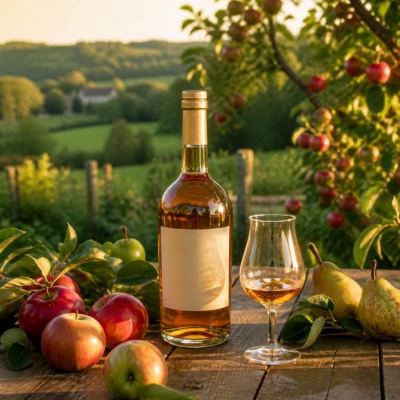
Calvados Pays d'Auge — the most prestigious, double distillation in pot still, apples and pears only, clay-limestone terroir
Calvados Domfrontais — minimum 30% cider pears mandatory, column distillation, very specific floral and fruity aromas
Calvados — generic appellation covering all of Normandy, column distillation authorised, more accessible style
Pommeau de Normandie — derived product, blend of apple juice and Calvados, served as an aperitif, very popular locally
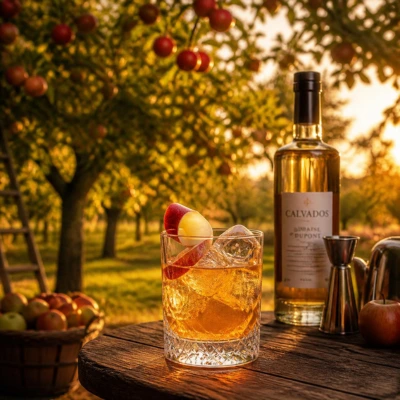
Calvados is experiencing a remarkable quality revival. A new generation of Norman producers is focusing on sustainable practices, organic farming, long ageing and modern communication to attract premium spirits enthusiasts internationally. Markets such as the United States, Japan and Scandinavia are growing strongly.
The valorisation of high-trunk orchards is also a major issue. These old Norman orchards, genuine landscape and biological heritage sites, are at the heart of Calvados quality. Their maintenance and renewal requires significant investment and specific expertise.
Finally, Calvados is increasingly making its mark in the world of premium cocktails. International bartenders are rediscovering its fruity aromas and versatility, opening new outlets for Norman producers.
Christian Drouin — Coudray-Rabut, Pays d'Auge, France
Boulard — Coquainvilliers, Pays d'Auge, France
Père Magloire — Pont-l'Évêque, Pays d'Auge, France
Château du Breuil — Le Breuil-en-Auge, Pays d'Auge, France
Lemorton — Ronfeugerai, Domfrontais, France
Domaine Dupont — Victot-Pontfol, Pays d'Auge, France
Busnel — Cormeilles, Pays d'Auge, France
Adrien Camut — Gonneville-la-Mallet, Pays d'Auge, France
Roger Groult — Saint-Cyr-du-Ronceray, Pays d'Auge, France
Coeur de Lion — Cambremer, Pays d'Auge, France
Étienne Dupont — Victot-Pontfol, Pays d'Auge, France
Piednoel — Crèvecoeur-en-Auge, Pays d'Auge, France
Domaine du Hautbois — Canapville, Pays d'Auge, France
Vergier — Saint-Julien-de-Mailloc, Pays d'Auge, France
Ferme de la Haie Renaut — Crouttes, Pays d'Auge, France
Manoir de la Louveterie — La Chapelle-Hareng, France
François Guy — Beuvron-en-Auge, Pays d'Auge, France
Domaine de Beaurepaire — Saint-Cyr-du-Ronceray, France
Le Sauveur — Saint-Pierre-sur-Dives, Normandie, France
Poutrel — Cambremer, Pays d'Auge, France
Brard Blanchard — Normandie, France
Lafontan Calvados — Surville, Pays d'Auge, France
Delaunay — Saint-Pierre-de-Manneville, Normandie, France
Domaine du Coteau — La Chapelle-sur-Dun, France
Ferme de la Grange — Cambremer, Pays d'Auge, France
Les Héritiers du Père Benoît — Normandie, France
Would you like your company to appear on this page? Listings are reserved for Pro Premium members of Wine BHM.
Join the selection of producers on the platform.
Join the network*Featured listings are reserved for Pro Premium members, subject to terms and conditions.