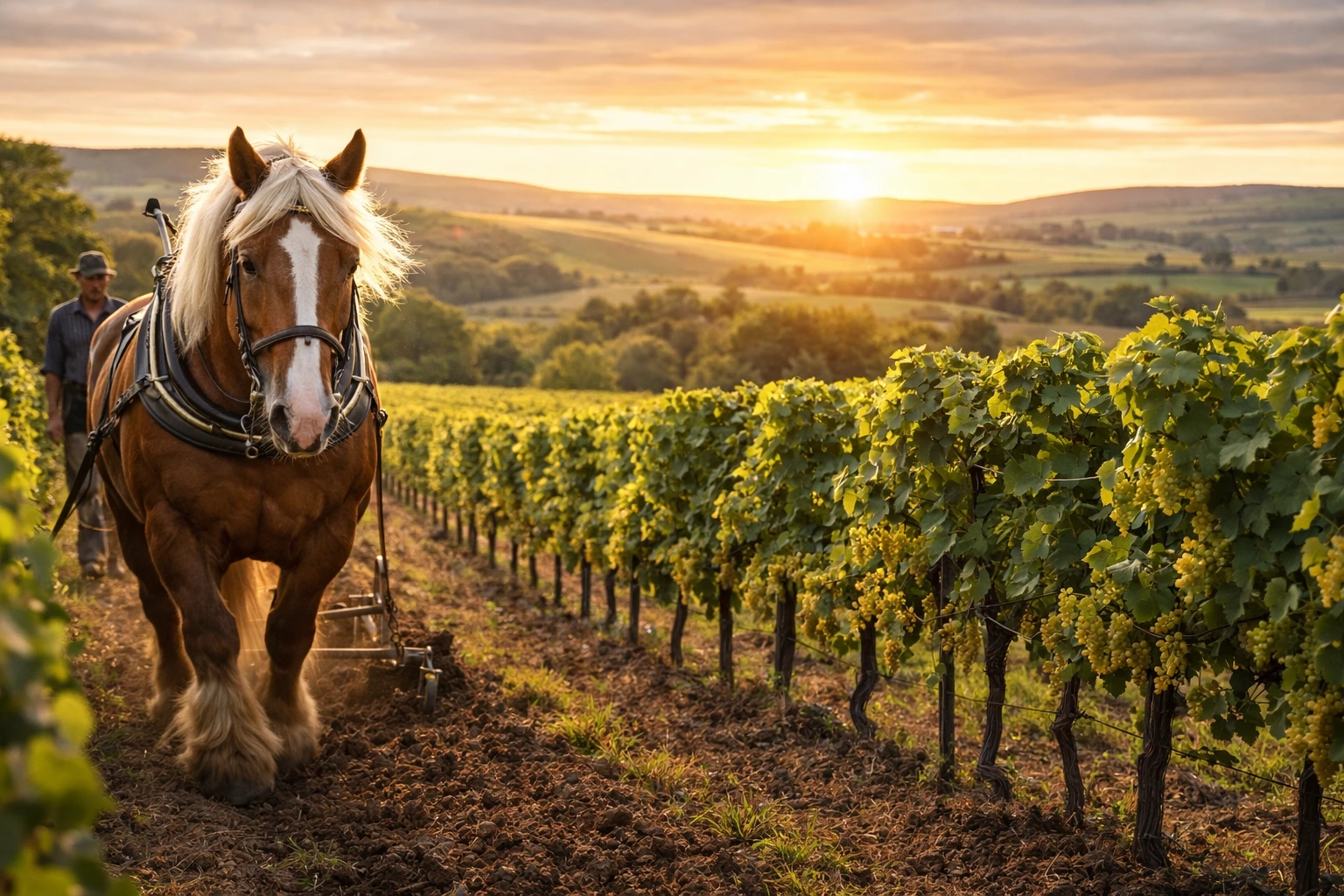
Long confined to the realm of picturesque imagery, the draft horse has staged a remarkable comeback in the world's most demanding vineyards since the 1990s. Far from mere nostalgia, this choice responds to agronomic, environmental and philosophical imperatives that no tractor, however sophisticated, can fully meet.
Before the mass mechanisation of the 1950s and 1960s, draft horses were the universal standard in European vineyards. Percherons, Comtois, Breton drafts and Belgian Brabançons pulled ploughs, sprayers and harvest carts through rows too narrow for any motorised equipment. Mechanisation ended this partnership within just a few decades, in the name of productivity.
It was in the great domaines of Burgundy that the revival first took root. Estates such as Domaine Leroy, Domaine de la Romanée-Conti and Château Pontet-Canet in Pauillac brought horses back to the heart of vineyard work, gradually inspiring a growing circle of growers across France, Italy, Spain and the New World.
The most thoroughly documented benefit of the draft horse lies in the protection of soil structure. A standard vineyard tractor, even a compact model, exerts ground pressure of 1.5 to 3 kg/cm². A horse, depending on its build, rarely exceeds 0.8 to 1.2 kg/cm², a pressure comparable to that of a walking person. The difference is decisive.
Compaction and microbial life: repeated passes by heavy machinery destroy macropores, reduce soil porosity and progressively suffocate the edaphic fauna (earthworms, mycorrhizal fungi, bacteria) that drives natural fertility. Horses preserve these micro-ecosystems, a prerequisite for the authentic expression of terroir.
In appellations with heavy clay soils, such as Pomerol or certain areas of Gevrey-Chambertin, this argument carries direct economic weight: compacted soil demands more inputs, produces less consistent yields and ages poorly.
The horse possesses a situational awareness that no machine can replicate. It naturally adapts its pace, weight distribution and balance to changes in terrain, slopes and narrow rows. It can work within centimetres of vine stocks without causing damage, where a tractor requires a wider safety margin.
Its hooves, with appropriate shoeing for stony or clayey soils, leave a clean and precise imprint. The driver, in direct contact with the animal, instantly senses soil resistance and can adjust ploughing depth in real time. This haptic feedback between man, animal and earth represents a form of embodied agronomy that electronic sensors have yet to replicate.
The use of draft horses aligns naturally with organic and biodynamic approaches, whose specifications encourage the abandonment of synthetic inputs and the restoration of living balance in the soil. The Demeter certification, the global reference for biodynamics, recognises horse-drawn work as fully consistent with its principles.
Horse manure produced by the animals working the estate also constitutes a high-quality organic amendment, closing a short cycle of organic matter between stable and vine. Some biodynamic estates go so far as to prepare their 500 (cow manure) and 501 (quartz silica) preparations using equipment drawn by the same horses that plough their parcels.
Domaine Leroy, Vosne-Romanée, Burgundy — Full biodynamic conversion
Domaine de la Romanée-Conti, Vosne-Romanée, Burgundy — Biodynamic, partial horse-drawn work
Château Pontet-Canet, Pauillac, Bordeaux — Full biodynamic conversion
Domaine Zind-Humbrecht, Turckheim, Alsace — Demeter-certified biodynamic
Albet i Noya, Penedès, Spain — Pioneering organic, equine ploughing
Benziger Family Winery, Sonoma, California — Biodynamic, horses on steep parcels
Domaine Leflaive, Puligny-Montrachet, Burgundy — Certified biodynamic
Coulée de Serrant – Nicolas Joly, Savennières, Loire — Biodynamic pioneer in France
From an environmental standpoint, the draft horse emits incomparably less CO₂ than a combustion-engine tractor. Its carbon footprint, accounting for breeding, feed and veterinary care, remains broadly favourable when forage is produced locally. Some agronomic studies estimate that one horse replaces between 30 and 60 tractor passes per year on a medium-sized wine estate, with a reduction in carbon footprint of 40 to 70% for traction operations.
Horses do not compact tracks and headlands, do not contaminate groundwater with motor oil, and their presence supports functional biodiversity across the property. They fit naturally within a regenerative agriculture framework that extends well beyond the vineyard itself.
Returning to draft horses is not without challenges. Acquisition costs (between 3,000 and 15,000 euros depending on breed and training), together with stabling, feed, farriery and veterinary expenses, represent a significant annual investment. Add to this the training of horse handlers, the need to adapt certain implements, and the management of a living animal that operates on its own rhythms.
Horses cannot replace everything: phytosanitary treatments over large surfaces, mechanical harvesting and transport of the harvest remain in the domain of tractors and motorised vehicles. Horse-drawn work is therefore generally complementary, focused on ploughing, hilling, row clearing and fine interventions during the growing season.
The availability of qualified handlers and specialist viticulture harness training remains limited in several countries, though dedicated centres have been developing in France, Switzerland and Belgium since the early 2010s.
Not all draft breeds are equally suited to vineyard work. The essential criteria are manoeuvrability in confined spaces, a calm temperament, sound limbs and the capacity to sustain slow, steady work. Among the most widely used breeds:
The Comtois (France): docile and hardy, ideal for sloped terrain — Jura, Savoie
The Breton Draft (France): compact and powerful, popular in Brittany and the Loire Valley vineyards
The Percheron (France): versatile, used in Champagne and Burgundy for its pulling strength
The Haflinger (Austria/Italy): smaller stature, perfect for terraced vineyards — Alto Adige, Swiss Romande
The Noriker (Austria): well-adapted to steep terrain, common in Alpine Austrian and South Tyrolean vineyards
Beyond measurable agronomic benefits, the draft horse embodies a vision of wine and how it should be made. Its presence in the rows sends a message to enthusiasts and buyers alike: here, quality is non-negotiable, time cannot be compressed, and the relationship with living nature takes precedence over industrial logic.
In a global market where differentiation increasingly depends on authenticity and the traceability of practices, the winegrower who works with horses holds a powerful, credible and visually compelling story. This is not a step backwards. It is an avant-garde movement choosing to build the future at the pace of the living world.
Domaine Leroy, Vosne-Romanée, Burgundy, France
Domaine de la Romanée-Conti, Vosne-Romanée, Burgundy, France
Château Pontet-Canet, Pauillac, Bordeaux, France
Domaine Zind-Humbrecht, Turckheim, Alsace, France
Domaine Leflaive, Puligny-Montrachet, Burgundy, France
Domaine Huet, Vouvray, Loire Valley, France
Franck Fourcade, Bordeaux, France
Coulée de Serrant – Nicolas Joly, Savennières, Loire, France
Domaine Trapet Père & Fils, Gevrey-Chambertin, Burgundy, France
Château La Tour Figeac, Saint-Émilion, Bordeaux, France
Albet i Noya, Penedès, Spain
Benziger Family Winery, Sonoma, California, USA
Domaine de la Vougeraie, Prémeaux-Prissey, Burgundy, France
Château Climens, Barsac, Bordeaux, France
Would you like your business to appear on this page? Featured listings are reserved for Wine BHM Pro Premium members.

Join the selection of producers on the platform.
Join the network*Featured listings are reserved for Pro Premium members, subject to terms and conditions.