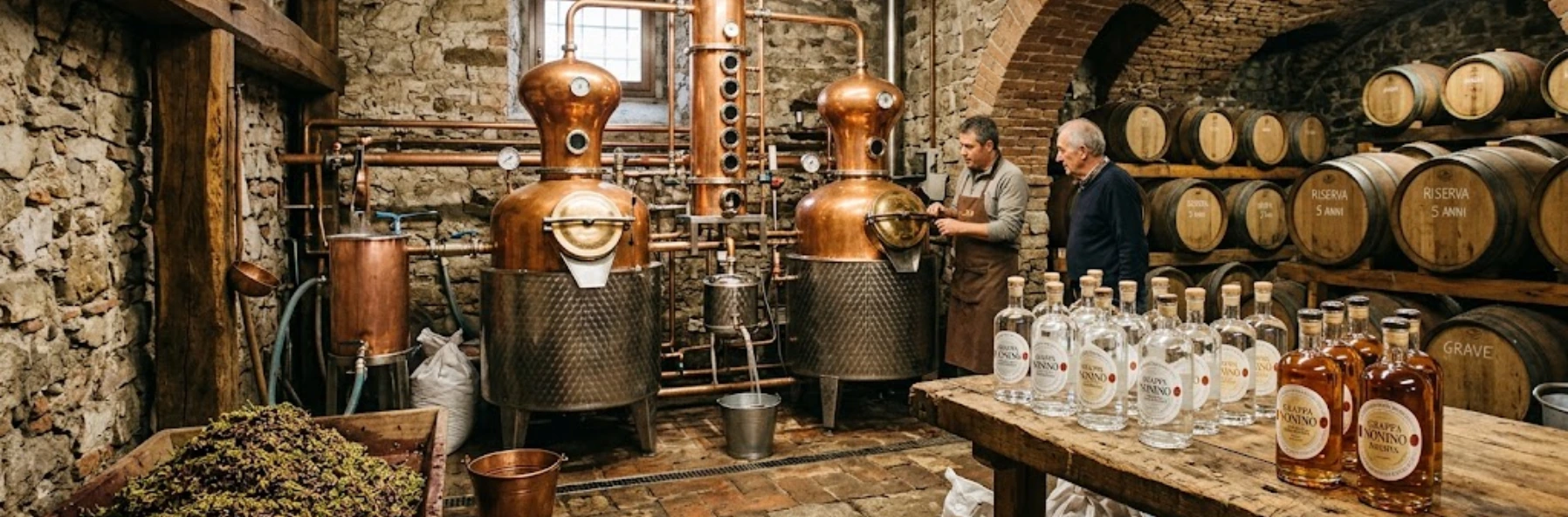
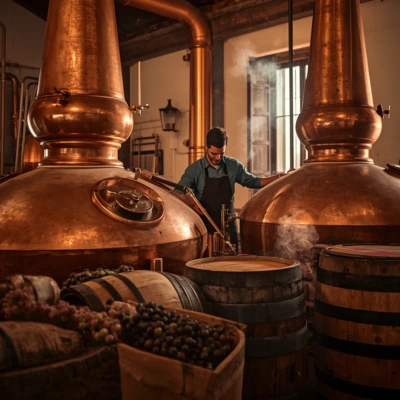
A Grappa producer is a distiller specialising in the elaboration of Grappa, an Italian grape marc brandy benefiting from a Protected Geographical Indication (PGI) exclusively Italian since 1989. Grappa is obtained by distilling grape marc — the skins, seeds and stalks remaining after the grapes have been pressed for winemaking. It is a spirit deeply rooted in Italian culture and identity.
The Grappa producer transforms a winemaking by-product into a characterful spirit, sometimes of great finesse. The quality of Grappa depends above all on the freshness of the marc used, the grape variety, the distillation method and any ageing. The best single-varietal Grappas, from a single noble grape variety such as Moscato, Barolo or Prosecco, are considered prestigious spirits.
The distillation of grape marc in Italy dates back at least to the Middle Ages, probably around the 13th or 14th century. The earliest written mentions appear in documents from the cities of Friuli and Piedmont. Originally, Grappa was a popular and peasant beverage, produced by winegrowers to avoid wasting marc after the harvest and to warm themselves during the long Alpine winters.
For centuries, Grappa remained an artisanal and domestic production, often clandestine, without great gastronomic consideration. It was in the 1970s-1980s that it experienced a true quality renaissance, thanks to visionary producers such as Romano Levi, Nonino and Jacopo Poli, who invested in artisanal bain-marie still distillation and in the valorisation of noble grape varieties.
Today, Grappa is internationally recognised as a prestige spirit, with single-varietal expressions highly sought after by enthusiasts worldwide. The export market represents a growing share of Italian production.
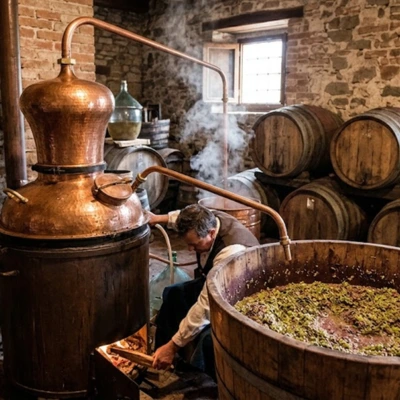
The Grappa producer receives or collects fresh marc immediately after pressing, as their quality deteriorates very quickly. The freshness of the marc is the first quality criterion of a great Grappa. The best producers work in close collaboration with winegrowers or wine cellars to receive marc of exceptional quality.
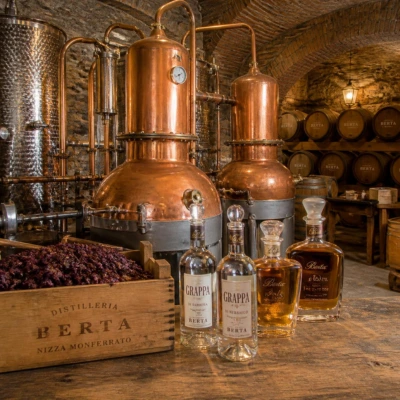
Bain-marie still distillation is the traditional and noble method of Grappa production. The still is heated indirectly by a water or steam bath, allowing gentle and progressive distillation that preserves the fine aromas of the marc. Continuous column distillation, less costly, is used for industrial productions.
Cask ageing is optional but highly enhancing: a Grappa Riserva aged in oak, acacia or cherry wood casks for at least 12 months acquires a roundness, complexity and amber colour that make it a remarkable contemplation spirit.
According to data from the Istituto Nazionale Grappa:
Approximately 35 million bottles of Grappa produced in Italy each year — Istituto Nazionale Grappa
Over 130 distilleries producing Grappa active in Italy — Istituto Nazionale Grappa
Approximately 20% of production destined for export, to 60 countries — Istituto Nazionale Grappa
Germany, Switzerland and the United States are the leading Grappa export markets
Trentino-Alto Adige, Friuli and Piedmont are the three historic producing regions
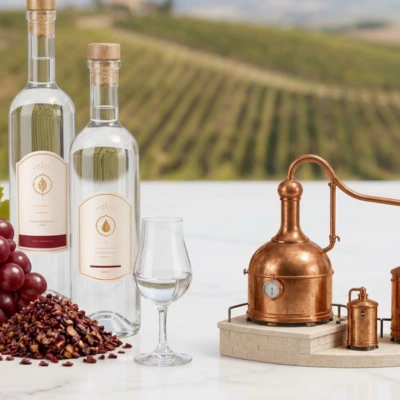
Grappa giovane — unaged, transparent, primary marc aromas, freshness and vivacity
Grappa invecchiata / Riserva — aged minimum 12 months in cask, amber colour, complex wood and spice aromas
Grappa monovitigno — from a single grape variety, pure grape expression, Moscato, Barolo, Amarone, Prosecco
Grappa aromatica — from aromatic varieties (Moscato, Gewurztraminer), very fragrant, floral
Grappa di Barolo — marc from the king of Piedmontese wines, maximum prestige, highly sought-after
Grappa di Prosecco — Glera marc, light and floral, very popular as an aperitif
Grappa del Friuli — Friulian tradition of excellence, Nonino as the world reference
Grappa trentina — Trentino-Alto Adige, Alpine influence, Marzadro and Pojer e Sandri
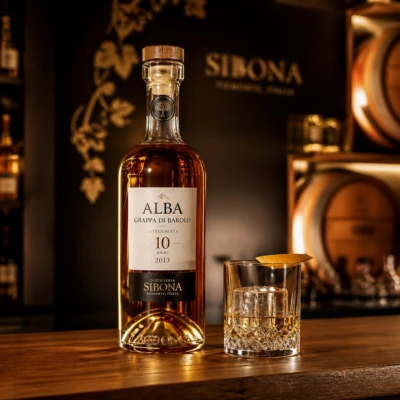
Grappa faces a generational challenge. Long associated with masculine and popular consumption, it is seeking to attract new generations of consumers discovering premium spirits. Producers are investing in bottle design, modern communication and presence in cocktail bars to reposition Grappa as a spirit of choice.
Quality Grappa is experiencing remarkable international growth. Spirits enthusiasts worldwide are discovering the great single-varietal and Riserva Grappas, which rival the best whiskies or Cognacs in complexity and finesse. This premium segment is the growth driver for the entire industry.
Finally, traceability and terroir connection are becoming leading marketing arguments. Producers who communicate on the grape variety, region, supplying winegrower and vintage of the marc used create a terroir narrative that resonates with today's engaged consumers.
Nonino — Percoto, Friuli, Italy
Jacopo Poli — Schiavon, Veneto, Italy
Nardini — Bassano del Grappa, Veneto, Italy
Marzadro — Nogaredo, Trentino, Italy
Pojer e Sandri — Faedo, Trentino, Italy
Maschio — Gaiarine, Veneto, Italy
Berta — Mombaruzzo, Piedmont, Italy
Bocchino — Canelli, Piedmont, Italy
Marolo — Alba, Piedmont, Italy
Pilzer — Faver, Trentino, Italy
Domenis 1898 — Cividale del Friuli, Friuli, Italy
Bottega — Bibano di Godega, Veneto, Italy
Vittorio Capovilla — Nogarole Vicentino, Veneto, Italy
Bepi Tosolini — Povoletto, Friuli, Italy
Banfi Grappa — Montalcino, Tuscany, Italy
Antinori Grappa — Florence, Tuscany, Italy
Gaja Grappa — Barbaresco, Piedmont, Italy
Carpene Malvolti Grappa — Conegliano, Veneto, Italy
Zanin — Vazzola, Veneto, Italy
Toschi — Savignano sul Panaro, Emilia, Italy
Zanolari — Brusino Arsizio, Ticino, Switzerland
Distilleria Erba — Ghemme, Piedmont, Italy
Folonari Grappa — Verona, Veneto, Italy
Casimiro — Bardolino, Veneto, Italy
Brunello Grappa — Montalcino, Tuscany, Italy
Grappa Julia — Palmanova, Friuli, Italy
Would you like your company to appear on this page? Listings are reserved for Pro Premium members of Wine BHM.
Join the selection of producers on the platform.
Join the network*Featured listings are reserved for Pro Premium members, subject to terms and conditions.