New Zealand is one of the world's youngest and most dynamic wine regions, yet one of the most influential. With approximately 42,500 hectares of vineyards spread across the North and South Islands, it produces 360 million liters per year (2023), nearly 90% of which is exported, generating over 2.1 billion New Zealand dollars in export revenue (2023–2024). It was Marlborough's Sauvignon Blanc that put the country on the global wine map in the 1980s, but it was Central Otago's Pinot Noir that confirmed this corner of the world could rival the greatest vineyards on the planet. One country, two islands, ten major regions, a striking diversity of terroirs.
New Zealand viticulture took root in 1819, when missionary Samuel Marsden planted the first vines in Kerikeri, Northland. James Busby, a British resident of New Zealand in the 1830s, continued this venture by cultivating his own vines near Waitangi. But the modern industry didn't truly take off until the mid-20th century, driven by pioneers such as Te Mata Estate (founded in 1896) and Mission Estate, the country's oldest winery still in operation. The quality revolution took off in 1985: Cloudy Bay's first Sauvignon Blanc, vinified by David Hohnen and Kevin Judd in the Marlborough region, shook up global markets and established New Zealand as a leading wine-producing nation. Growth was staggering: +17% per year between 2000 and 2020. In 2016, a law on Geographical Indications officially protected 21 regions and subregions. In 2023, Hawke's Bay was proclaimed a World Wine Capital, alongside Bordeaux, Napa Valley, and Verona.
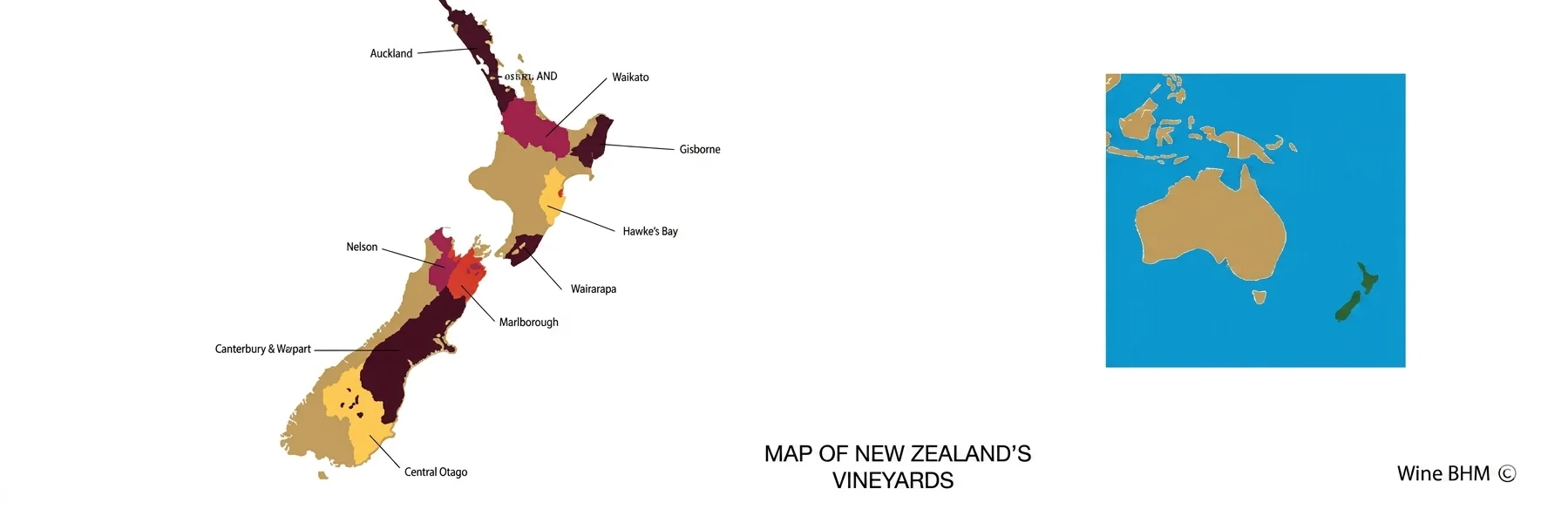
Marlborough: Over 30,000 hectares in the northeast of the South Island, accounting for two-thirds of the national vineyard area. The global birthplace of New Zealand Sauvignon Blanc and the largest single-region vineyard in the Southern Hemisphere. Subregions include Wairau Valley and Southern Valleys. Pinot Noir, Chardonnay, and Riesling are also excellent here.
Hawke's Bay: Approximately 4,600 hectares on the east coast of the North Island, the country's oldest wine region since 1851. Nicknamed "the New Zealand Bordeaux." Merlot, Syrah, and Cabernet blends on the Gimblett Gravels, a former riverbed with exceptional loose, well-draining gravel soils. Proclaimed World Wine Capital in 2023.
Central Otago: Approximately 2,000 hectares in the heart of the South Island, the world's southernmost wine region (45°S) and the highest in elevation. Extreme continental climate, day/night temperature swings of up to 20°C, schist and glacial loess soils. World-renowned Pinot Noir. Subregions: Bannockburn, Gibbston, Cromwell Basin, Bendigo, Alexandra.
Wairarapa / Martinborough: Approximately 1,000 hectares at the southern tip of the North Island, one hour from Wellington. A lesser-known region (3% of national production) but of remarkable quality. Structured and elegant Pinot Noir from Martinborough, often compared to Burgundy for its finesse and aging potential.
Gisborne: Approximately 1,200 hectares on the east coast of the North Island, the world's easternmost wine region. Nicknamed the "Chardonnay Capital of New Zealand." Fertile soils, rich and aromatic Chardonnay, high-quality Gewürztraminer.
Nelson: A small boutique region in the northwest of the South Island, two hours from Marlborough. Same grape varieties as Marlborough in a slightly cooler climate. Sauvignon Blanc, Pinot Noir, and Chardonnay from passionate artisans. New Zealand's sunniest region.
Auckland / Waiheke Island: The region boasts the largest number of wineries in the country. Waiheke Island, a 35-minute ferry ride from Auckland, is a hidden gem of a wine region: 30 boutique producers specializing in Bordeaux-style blends (Cabernet Sauvignon, Merlot, Cabernet Franc) and an elegant Syrah that is gaining increasing recognition.
North Canterbury / Waipara: A rapidly growing region north of Christchurch on the South Island. Limestone soils, dry and sunny climate. Pinot Noir and Riesling of great precision, Chardonnay with character. Bell Hill, a lesser-known producer in the region, ranks among the country's most sought-after wines.
Type: White, Red
Grape Varieties: Sauvignon Blanc, Pinot Noir, Chardonnay, Riesling, Pinot Gris
Style: The world capital of Sauvignon Blanc, lively, aromatic, and incomparably fresh, with increasingly complex Pinot Noirs from the Southern Valleys
Type: Red, White
Grape Varieties: Merlot, Syrah, Cabernet Sauvignon, Chardonnay, Viognier
Style: New Zealand's great reds, peppery and dark Syrahs from Gimblett Gravels, age-worthy Bordeaux blends, generous and complex Chardonnay
Type: Red, White
Grape Varieties: Pinot Noir, Pinot Gris, Chardonnay, Riesling
Style: The world's southernmost Pinot Noir, concentrated, deep, and mineral-driven on schist, with aromas of black cherry, plum, and spices, and absolute purity
Type: Red, White
Grape Varieties: Pinot Noir, Sauvignon Blanc, Riesling, Pinot Gris
Style: Characterful Pinot Noir, more earthy and structured than Central Otago, with remarkable aging potential. A small-scale production with a high reputation
Type: White
Grape Varieties: Chardonnay, Gewürztraminer, Viognier
Style: Rich and aromatic Chardonnay with notes of pineapple and melon; tropical Gewürztraminer. The world's easternmost wine region
Type: Red, White
Grape Varieties: Cabernet Sauvignon, Merlot, Cabernet Franc, Syrah, Chardonnay
Style: A hidden gem on Auckland's doorstep, featuring elegant Bordeaux-style blends and refined Syrah produced by 30 of the country's most sought-after boutique producers
New Zealand's iconic grape variety, accounting for over 28,000 hectares, or 65%, of the country's vineyards. It is in Marlborough that it achieves its most distinctive expression in the world: vibrant citrus, passion fruit, boxwood, herbaceous notes, crisp acidity, and unparalleled freshness. No region in the world produces a Sauvignon Blanc as instantly recognizable. The Single Vineyard versions from Greywacke or Dog Point Section 94 demonstrate a complexity and depth capable of rivaling the finest Sancerres.
Food pairings: Seafood, oysters, goat cheese, asparagus, marinated fish, sushi.
New Zealand's premier red grape variety, the king of Central Otago, Martinborough, and Marlborough. In Central Otago, on schist and glacial loess soils, it develops a concentration, mineral depth, and aromatic purity unmatched in the Southern Hemisphere. Black cherry, plum, violet, sweet spices, earthy notes with age. Felton Road Block 3 and Block 5, Martinborough's Ata Rangi, and Central Otago's Rippon are among the world's most admired and sought-after Pinot Noirs, compared to great Burgundies in blind tastings.
Food pairings: Roast duck, lamb, poultry with wild mushrooms, aged cheeses.
Found in every region, New Zealand Chardonnay reaches its peak in Hawke's Bay, where it is produced as a generous, complex, barrel-aged wine, and in Gisborne, where it is aromatic and exuberant. Kumeu River, north of Auckland, produces Chardonnays regularly compared to the finest Burgundy whites. The natural acidity preserved by the maritime climate is the hallmark of these wines.
Food pairings: Lobster, scallops, poultry in cream sauce, truffle risotto, fine fish.
New Zealand's big surprise. In Hawke's Bay, on the Gimblett Gravels, it produces wines with a complexity that rivals that of the northern Rhône: black pepper, violet, smoked meat, black olive, an elegant tannic structure, and remarkable depth. Craggy Range, Trinity Hill, and Te Mata are the most admired producers. Waiheke Island also offers Syrahs of striking finesse.
Food pairings: Spiced lamb, game, grilled meats, hard cheeses.
The white grape variety on the rise in New Zealand. Marlborough, Central Otago, and Nelson produce dry or slightly sweet versions, with notes of pear, white peach, and mild spices. Highly appreciated for its versatility in food pairings, it is one of the most accessible white table wines from New Zealand vineyards.
Food pairings: Asian cuisine, roast pork, mild cheeses, fish in sauce.
A low-key but high-quality grape variety in New Zealand, particularly in the cooler regions of Marlborough, Central Otago, and North Canterbury. It produces wines with lively acidity and sharp minerality, ranging from dry to off-dry, with remarkable aging potential. Felton Road offers several outstanding expressions, from dry to the German Spätlese style.
Food pairings: Thai and Asian cuisine, seafood, goat cheese, spicy poultry.
Cloudy Bay (Marlborough), The winery that put New Zealand on the global wine map. Its 1985 Sauvignon Blanc, crafted by Kevin Judd, transformed the world's perception of the grape variety. Now owned by the LVMH group, Cloudy Bay remains the gold standard for Marlborough Sauvignon Blanc.
Felton Road (Central Otago), Ranked number one among New Zealand wineries by many critics. Its Block 3 and Block 5 Pinot Noirs, produced from organic, biodynamic vineyards, are among the most admired and sought-after in the Southern Hemisphere. The benchmark of Central Otago.
Ata Rangi (Martinborough), Founded in 1980 by Clive Paton on a former sheep pasture, this pioneering estate has become the benchmark for Martinborough Pinot Noir. Its Ata Rangi Pinot Noir received the inaugural title of "Grand Cru of New Zealand" in 2010. Certified organic vineyards, limited production, global demand.
Te Mata Estate (Hawke's Bay), Founded in 1896, New Zealand's oldest active winery, still family-owned. Its Coleraine, a blend of Cabernet Sauvignon, Merlot, and Cabernet Franc, is considered one of the country's greatest red wines. Elston Chardonnay and Bullnose Syrah round out an exceptional portfolio.
Craggy Range (Hawke's Bay / Martinborough), One of the country's most ambitious estates, founded in 1998 with the stated goal of competing with the world's greatest wineries. Sophia (a Bordeaux-style blend), Aroha Pinot Noir, and Le Sol Syrah from the Gimblett Gravels are icons of New Zealand winemaking.
Greywacke (Marlborough), The personal label of Kevin Judd, founder and former winemaker at Cloudy Bay for 25 vintages. His Single Vineyard Sauvignon Blancs and Pinot Noirs are more austere, more complex, and more ambitious than the Marlborough standard. The vision of a craftsman at the peak of his art.
Kumeu River (Auckland), The benchmark for New Zealand Chardonnay. Michael Brajkovich, New Zealand's first Master of Wine, produces Chardonnays regularly compared to the finest white Burgundies. His Mate's Vineyard Chardonnay is a landmark of New Zealand winemaking.
Rippon (Central Otago), One of the world's most beautiful vineyards, on the shores of Lake Wanaka framed by the Southern Alps. Practicing full biodynamics, it produces Pinot Noirs of exceptional purity and elegance, and Rieslings with great minerality. A benchmark estate for both philosophy and quality.
New Zealand is one of the world's most spectacular wine tourism destinations. In Marlborough, the Wairau Valley wine routes can be explored by bike between tastings, with views of the Richmond Range. In Central Otago, the wineries are nestled among the snow-capped peaks of the Southern Alps, glacial lakes, and the schist gorges of Gibbston Valley, a landscape unmatched anywhere else in the wine world.
Hawke's Bay offers a wine route between Napier, a one-of-a-kind Art Deco city rebuilt after the 1931 earthquake, and Hastings. The Gimblett Gravels are among the most beautiful wine routes in the Southern Hemisphere. In Martinborough, the historic village is surrounded by fewer than fifty boutique wineries within walking distance, offering an incomparable artisanal and intimate atmosphere.
Waiheke Island, a 35-minute ferry ride from Auckland, is nicknamed the "wine island": top-tier tastings, gourmet restaurants with views of the Hauraki Gulf, and Bordeaux blends and Syrah wines not available for export. An exceptional wine getaway for any serious enthusiast.
Bluff oysters (New Zealand's most renowned) with a Marlborough Sauvignon Blanc.
Roasted New Zealand lamb with a Central Otago Pinot Noir or a Syrah from the Gimblett Gravels.
Kaikoura lobster with a Kumeu River Chardonnay or a Hawke's Bay Chardonnay.
White fish ceviche with a Greywacke or Dog Point Single Vineyard Sauvignon Blanc.
Maori hangi (lamb and vegetables cooked using geothermal steam) with a Pinot Noir from Martinborough.
Asian cuisine (Thai, Japanese) with a semi-dry Riesling from Central Otago or a Pinot Gris from Marlborough.
Would you like to list your winery or promote it on Wine BHM? Contact us at winebhm.com
Join the selection of producers on the platform.
Join the network*Featured listings are reserved for Pro Premium members, subject to terms and conditions.