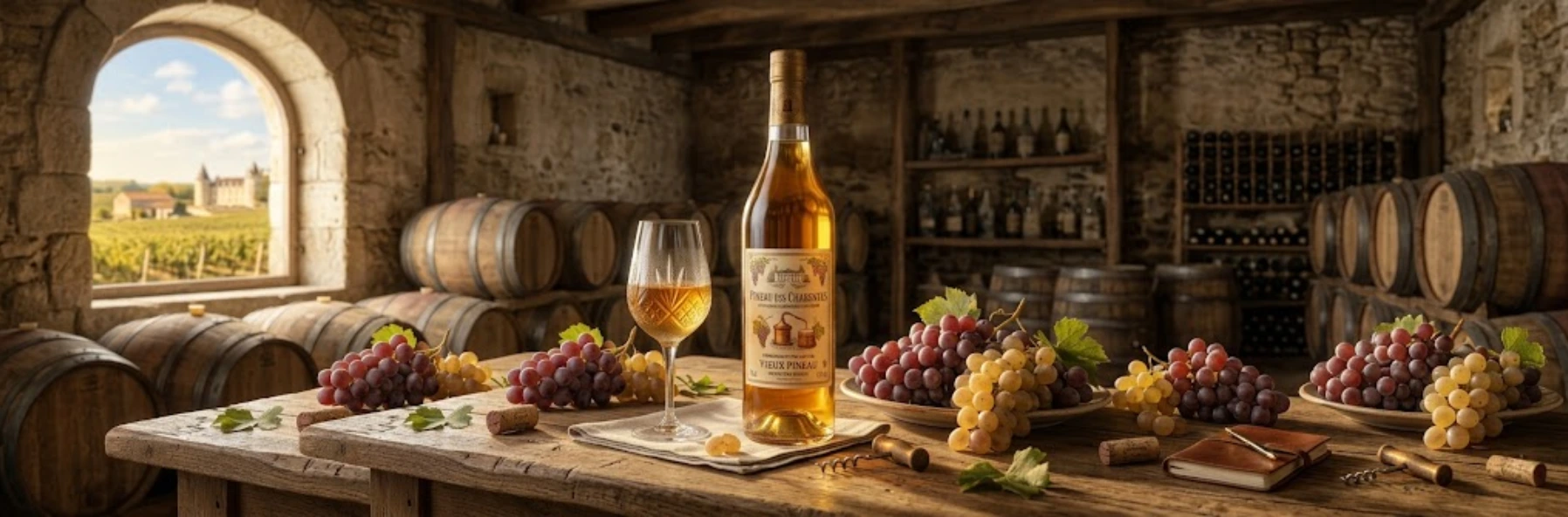
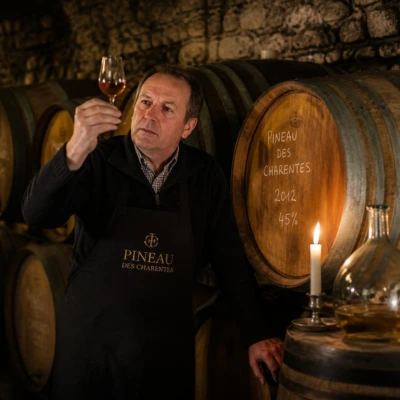
A Pineau des Charentes producer is a winegrower-distiller specialising in the elaboration of Pineau des Charentes, a liqueur wine AOC exclusively produced in the Charente and Charente-Maritime departments of France. Pineau is obtained by blending fresh grape must (unfermented grape juice) with young Cognac, in precise proportions defined by the appellation specifications.
It is a product unique in the world, halfway between sweet wine and spirit, expressing both the fruity richness of Charente grapes and the aromatic power of Cognac. Pineau des Charentes is served as an aperitif, chilled or very cold, and pairs perfectly with foie gras, seafood and fruit-based desserts.
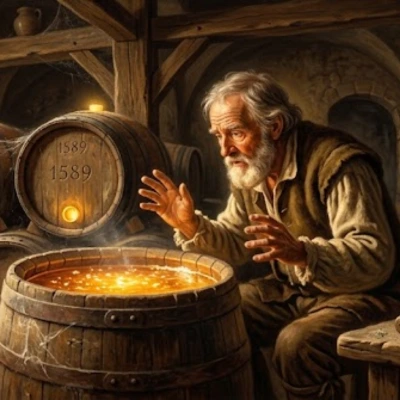
The legend of Pineau des Charentes dates back to 1589. According to tradition, a Charente winegrower accidentally poured fresh grape must into a cask containing leftover Cognac. Forgotten for several years, upon his return he discovered an amber, sweet and aromatic liquid that immediately appealed to him.
For centuries, Pineau remained a confidential production, consumed locally by winegrowers and their families. It was only in the 20th century that it began to be commercially structured. The Pineau des Charentes AOC was officially recognised in 1945, making it one of the first French liqueur wines to benefit from a protected appellation.
Today, Pineau des Charentes is experiencing renewed interest, particularly among new generations of consumers who appreciate its complex aromas, natural sweetness and strong territorial identity.
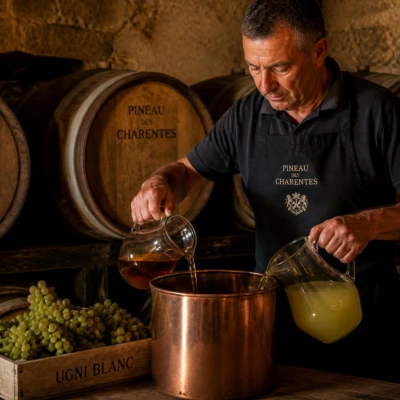
Pineau des Charentes production is closely linked to that of Cognac. The producer cultivates the same Charente grape varieties, primarily Ugni Blanc, and vinifies part of the harvest as fresh must, which is immediately fortified with Cognac produced on their own estate.
The blend must respect precise proportions: approximately three quarters grape must to one quarter Cognac, with the final alcohol content between 16 and 22% vol. The blend is then aged in oak casks for a minimum of one year for white Pineau, and eighteen months for rosé and red Pineau.
Tasting and quality control are essential steps. Each batch of Pineau must be presented to the interprofessional tasting panel which validates or refuses its right to the AOC. This control guarantees the consistency and quality of the appellation.
According to the Syndicat de Défense du Pineau des Charentes:
Approximately 600 producers of Pineau des Charentes recorded in the region — Syndicat du Pineau
Over 500,000 hectolitres of Pineau produced on average per year — Syndicat du Pineau
Approximately 15 million bottles sold per year — Syndicat du Pineau
Over 60 countries importing Pineau des Charentes — Syndicat du Pineau
Three colours: white (the most produced), rosé and red
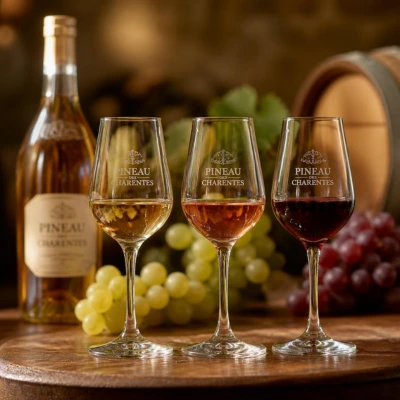
White Pineau — from white grape varieties (Ugni Blanc, Folle Blanche, Colombard), aromas of white fruits and honey, minimum 1 year ageing
Rosé Pineau — from red grape varieties (Cabernet Franc, Cabernet Sauvignon, Merlot), fresh red fruit aromas, minimum 18 months ageing
Red Pineau — same grape varieties as rosé but longer maceration, deeper colour, black fruit and spice aromas
Vieux Pineau — minimum 5 years ageing for white, 10 years for red, highly developed aromatic complexity
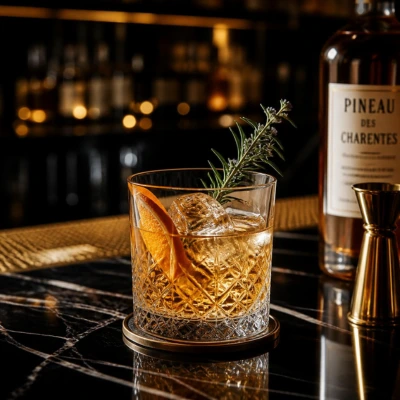
Pineau des Charentes faces the challenge of repositioning itself. Long perceived as a traditional and regional aperitif, it is seeking to attract new consumers, particularly younger generations more accustomed to still wines and premium spirits. Modern communication initiatives and gastronomic experimentation are contributing to this revival.
The diversification of uses is also a strong trend. Pineau is increasingly appearing in cooking (sauces, marinades, desserts), premium cocktails and original food and wine pairings, which broadens its potential consumer base.
Finally, export development remains a priority challenge. While Pineau is well established in certain European markets, it remains little known in many regions of the world where it could appeal to lovers of sweet and fruity spirits.
Pierre Ferrand — Merpins, Charente, France
Guy Pinard et Fils — Coulonges, Charente, France
Château Paulet — Cognac, Charente, France
Domaine des Forges — Segonzac, Charente, France
Hardy Pineau — Cognac, Charente, France
Camus Pineau — Cognac, Charente, France
Rémy Martin Pineau — Cognac, Charente, France
Grosperrin — Saintes, Charente-Maritime, France
Domaine du Peyrat — Bouteville, Charente, France
Vignobles Roussille — Barbezieux, Charente, France
Château de Beaulon — Saint-Dizant-du-Gua, Charente-Maritime, France
Domaine de Montifaud — Louzac-Saint-André, Charente, France
Domaine de la Chauvinière — Gimeux, Charente, France
Vignoble Audouin — Châteaubernard, Charente, France
Domaine Barraud — Mainxe, Charente, France
Geffard Pineau — Foussignac, Charente, France
Vignoble Lambert — Segonzac, Charente, France
Girard Pineau — Réparsac, Charente, France
Domaine Moulinard — Saint-Fort-sur-le-Né, Charente, France
Vignoble Couillaud — Cherves-Richemont, Charente, France
Chainier Pineau — Cognac, Charente, France
Germain et Associés — Cognac, Charente, France
Gauthier Pineau — Jarnac, Charente, France
Domaine de la Tour — Segonzac, Charente, France
Briand Pineau — Cognac, Charente, France
Domaine Boingnères Pineau — Calonges, Charente, France
Would you like your company to appear on this page? Listings are reserved for Pro Premium members of Wine BHM.
Join the selection of producers on the platform.
Join the network*Featured listings are reserved for Pro Premium members, subject to terms and conditions.