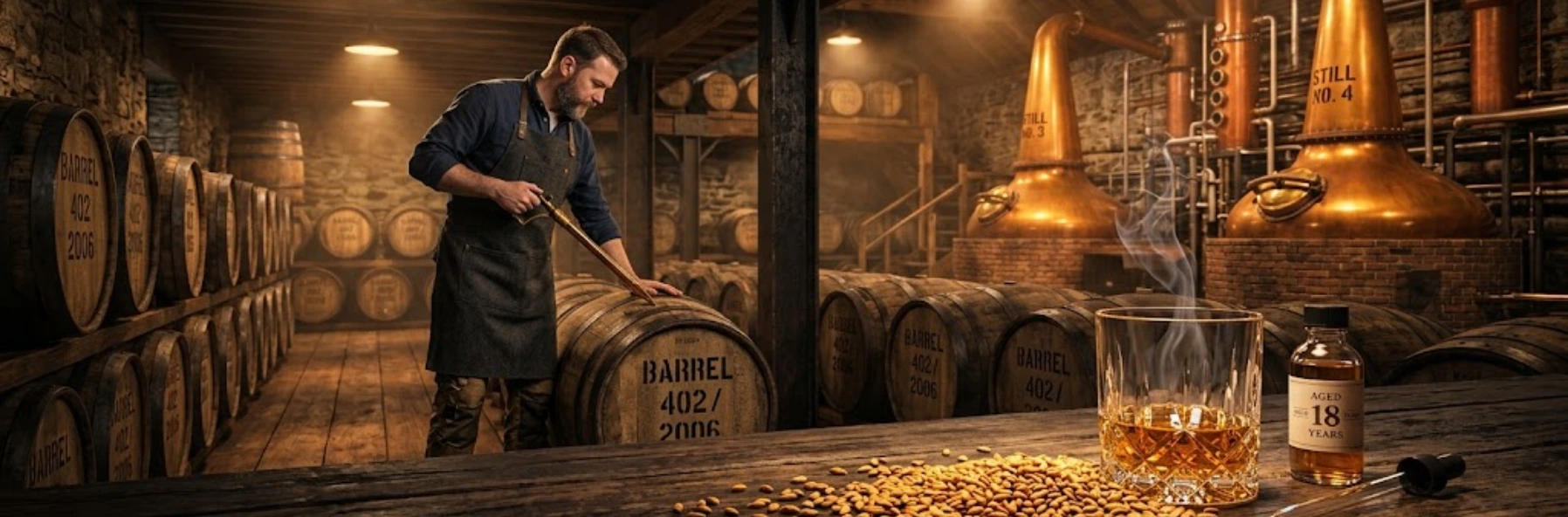
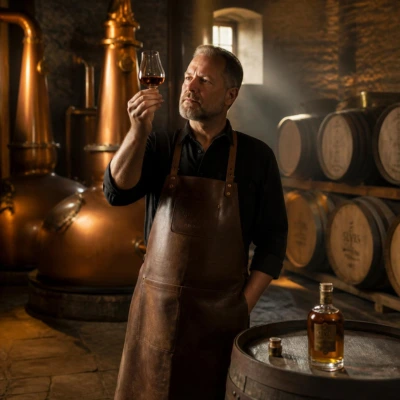
A whisky producer is a distiller specialising in the elaboration of whisky, a spirit obtained by the fermentation and distillation of malted or unmalted cereals (barley, corn, rye, wheat), then mandatorily aged in oak casks. Whisky is one of the most consumed and most collected spirits in the world, with deeply rooted production traditions in Scotland, Ireland, the United States, Japan and many other countries.
A whisky producer masters a complex production chain that goes from cereal malting to distillation, via fermentation and long cask ageing. Every decision, from the choice of cereals to the type of cask, shapes the final aromatic profile of the whisky.
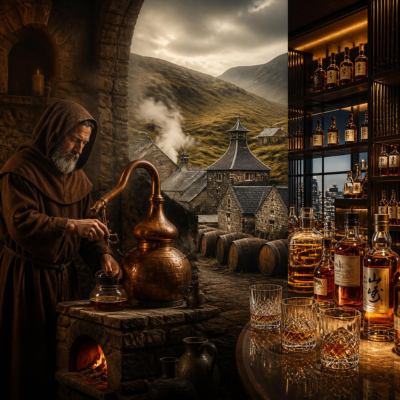
The origin of whisky dates back to the 15th century in Scotland and Ireland, where monks distilled fermented barley to produce aqua vitae (water of life). The first written mention of whisky in Scotland dates from 1494, in the Scottish Exchequer Rolls, which mention the delivery of malt to a Brother John Cor for the making of water of life.
For centuries, production remained artisanal and often clandestine, particularly due to taxes imposed by the British Crown. It was not until the Excise Act of 1823 that legal production developed massively in Scotland, giving birth to the great distilleries that brought Scotch whisky its worldwide renown.
In the 20th century, whisky went global. American bourbon conquered international markets after Prohibition, Japanese whisky emerged in the 1920s with Suntory and Nikka, and today craft distilleries are springing up on every continent, from France to India via Taiwan and Australia.
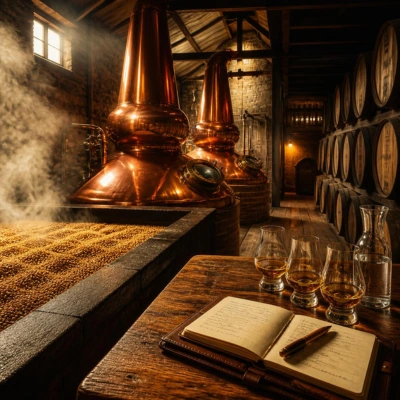
Whisky production begins with malting: barley is soaked, germinated then dried (sometimes over peat fire for the peated whiskies of Islay). The malt is then milled and mashed with hot water to extract the sugars, before being fermented by yeasts for 48 to 96 hours.
Distillation takes place in copper pot stills (for single malts) or continuous column stills (for grain whiskies). The shape and size of the stills directly influence the aromatic profile of the spirit. Ageing in oak casks is then mandatory, often in casks that previously held bourbon, Sherry, Port or wine.
Blending is finally the art of the master blender: for blended whiskies, they select and combine single malt and grain spirits to create a harmonious and consistent aromatic profile.
According to data from the Scotch Whisky Association (SWA) and the IWSR:
Over 5 billion bottles of whisky sold worldwide each year — IWSR
£6.2 billion in Scotch whisky exports in 2022 — SWA
Over 140 active distilleries in Scotland — SWA, 2023
Over 2,000 bourbon distilleries in the United States — Distilled Spirits Council
Japan has over 50 active distilleries — Japan Spirits and Liqueurs Makers Association
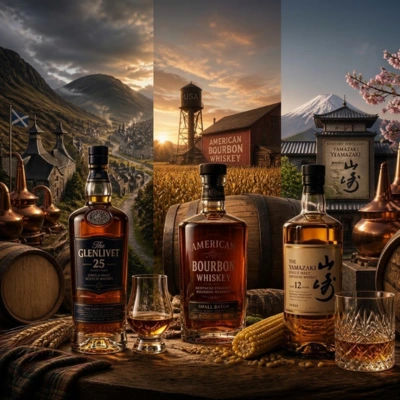
Scotch Single Malt — Scotland, 100% malted barley, single distillery, minimum 3 years in cask
Scotch Blended — Scotland, blend of single malts and grain whiskies, accessible style
Irish Whiskey — Ireland, often triple distilled, light and fruity style
Bourbon — USA (mainly Kentucky), minimum 51% corn, new oak casks
Tennessee Whiskey — USA, charcoal filtration (Lincoln County Process)
Rye Whiskey — USA and Canada, minimum 51% rye, spicy and dry
Japanese Whisky — Japan, inspired by Scotch, exceptional precision and balance
Indian Whisky — India, world's largest market by volume, varied style
Taiwanese Whisky — Taiwan, Kavalan, very particular tropical climate ageing
Australian Whisky — Australia, particularly Tasmania, growing quality
French Whisky — France, emerging trend with craft distilleries across all regions
Welsh Whisky — Wales, revival of the distilling tradition with Penderyn
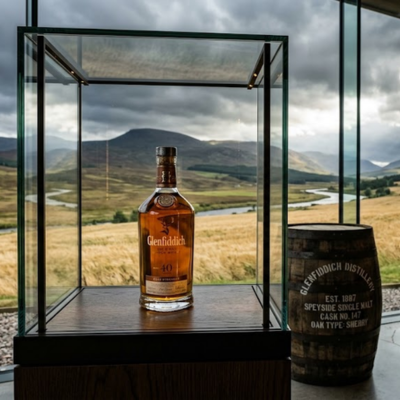
Whisky is living through a global golden age. Demand for exceptional single malts and limited editions continues to grow, driven by collectors and investors worldwide. Rare whisky auctions are setting historical records, with some bottles selling for several hundreds of thousands of dollars.
The rise of craft distilleries is a fundamental trend across all producing countries. In France, Belgium, Australia, Sweden and India, new distilleries are creating locally expressive whiskies, showcasing indigenous cereals, specific terroirs and innovative ageing methods.
Climate change is also impacting production, particularly water resources and ageing conditions. Scottish and Irish distilleries must adapt their practices to maintain the quality and consistency of their expressions.
Glenfiddich — Dufftown, Speyside, Scotland
The Balvenie — Dufftown, Speyside, Scotland
The Macallan — Craigellachie, Speyside, Scotland
Laphroaig — Port Ellen, Islay, Scotland
Highland Park — Kirkwall, Orkney, Scotland
Glenmorangie — Tain, Highlands, Scotland
Jameson — Cork, Ireland
Bushmills — Bushmills, Northern Ireland
Maker's Mark — Loretto, Kentucky, USA
Woodford Reserve — Versailles, Kentucky, USA
Jack Daniel's — Lynchburg, Tennessee, USA
Nikka — Yoichi, Hokkaido, Japan
Suntory – Yamazaki — Osaka, Japan
Kavalan — Yilan, Taiwan
Penderyn — Penderyn, Wales
Sullivan's Cove — Cambridge, Tasmania, Australia
Amrut — Bangalore, India
Paul John — Goa, India
Warenghem – Armorik — Lannion, Brittany, France
Brenne — Charente, France
Hepp — Uberach, Alsace, France
Springbank — Campbeltown, Scotland
Bruichladdich — Islay, Scotland
Ardbeg — Port Ellen, Islay, Scotland
Oban — Oban, Highlands, Scotland
Distillerie de Mézerac — Mézérac, France
Would you like your company to appear on this page? Listings are reserved for Pro Premium members of Wine BHM.
Join the selection of producers on the platform.
Join the network*Featured listings are reserved for Pro Premium members, subject to terms and conditions.