Austria is one of the most singular vineyards in Europe. With 44,210 hectares of vines concentrated in the east of the country, it produces approximately 653,000 hectolitres per year (2023), of which 65 million litres are exported for a record value of 248 million euros. At 68%, it is a country of dry white wines of incomparable precision and minerality, dominated by Grüner Veltliner and Riesling from the valleys of the Wachau, Kamptal and Kremstal, which rank among the most admired dry whites in the world. But it is also the country of the profound Blaufränkisch of Burgenland, the legendary sweet wines of the Neusiedlersee and the high-altitude Sauvignon Blancs of Styria. A human-scale vineyard, almost exclusively family-owned, that completely reinvented itself after the 1985 scandal to become a global quality reference.
Austrian viticulture dates back more than 4,000 years — Bronze Age wine presses have been found in Lower Austria. The Celts and then the Romans developed the vineyard along the Danube. In the 16th century, Austria reached its viticultural apogee with up to 200,000 hectares of vines — three times the current surface area. The Thirty Years' War and high taxes devastated the vineyard in the 17th century. The modern qualitative renaissance began paradoxically in 1985, following the diethylene glycol scandal, when unscrupulous merchants adulterated wines with a chemical product: the scandal destroyed the market and forced Austria to a complete overhaul of its wine laws. In 1985, Austria adopted one of the strictest viticultural regulations in the world. In 1992, the Vinea Wachau was founded, introducing the three-level classification of Steinfeder, Federspiel and Smaragd. In 2002, the DAC (Districtus Austriae Controllatus) system was created, the Austrian equivalent of controlled appellations, progressively extended to all regions. Today, more than 10,000 wine estates, almost exclusively family-owned, cultivate an average of 4.4 hectares.
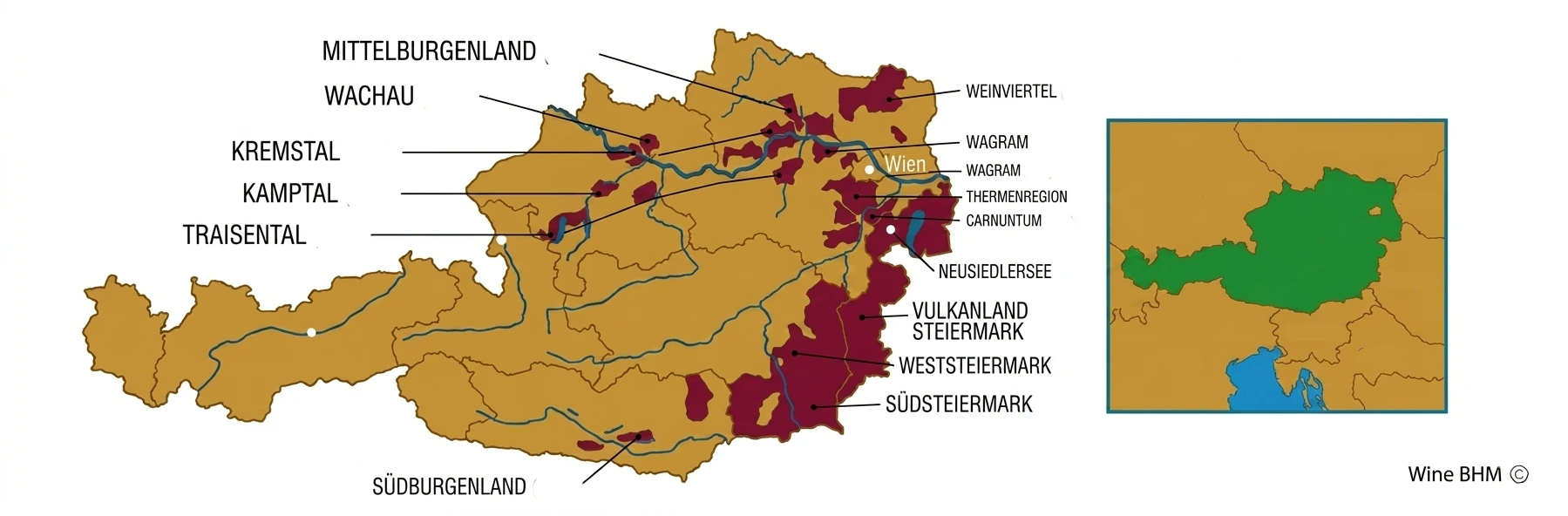
Lower Austria (Niederösterreich): 26,732 ha, the largest wine region in Austria, producing approximately 67% of national production. It groups eight DAC sub-regions: Wachau, Kremstal, Kamptal, Wagram, Traisental, Weinviertel, Carnuntum and Thermenregion. Three distinct climatic zones coexist — from the continental Weinviertel in the north to the granite terraces of the Danube in the west. Austria's greatest dry Rieslings and Grüner Veltliners were born here.
Wachau: The absolute jewel of the Austrian vineyard, classified as a UNESCO World Heritage Site. Steep granite and gneiss terraces along the Danube, between Melk and Krems. Exceptional microclimate between warm Pannonian influences and alpine freshness. Unique three-level classification: Steinfeder (light), Federspiel (intermediate) and Smaragd (powerful, for ageing). The world's greatest dry Rieslings and Grüner Veltliners come from here.
Kamptal: The Kamp river valley north of Krems, around the wine town of Langenlois. Loess and sandstone soils, optimal south-facing exposure, cool nights. Grüner Veltliner and Riesling of a precision and complexity rivalling the Wachau, at often more accessible prices. The Heiligenstein and Gaisberg vineyards are among the most admired in the country.
Kremstal: Region around the town of Krems, natural eastward extension of the Wachau. Varied loess, gneiss and sandstone soils, producing mineral Rieslings and fresh, structured Grüner Veltliners. The Ried Steiner Kögl vineyard and the wines of Domaine Nigl are among the region's references.
Weinviertel: The largest sub-region of Lower Austria, north of the Danube to the Czech and Slovak borders. Austria's first DAC (2002). Speciality: fresh and peppery Grüner Veltliner with an immediately recognisable signature character, known as "Pfefferl" (a small peppery note). Accessible, lively and gastronomic wines.
Burgenland: 11,538 ha in the east of the country, along the Hungarian border. Hot Pannonian continental climate. Four sub-regions: Neusiedlersee, Leithaberg, Mittelburgenland and Eisenberg. Austria's capital of powerful red wines (Blaufränkisch, Zweigelt) and world-class sweet wines produced thanks to noble rot favoured by the mists of Lake Neusiedl. Ruster Ausbruch, one of the most prestigious sweet wines in the world.
Styria (Steiermark): 5,109 ha in south-east Austria, on the Slovenian border. A region of green hills, cooler and more humid climate, volcanic and clay soils. Three sub-regions: Südsteiermark, Weststeiermark and Vulkanland. Sauvignon Blancs of incomparable purity and minerality in Südsteiermark. Schilcher, the iconic rosé produced exclusively from Blauer Wildbacher in Weststeiermark. Morillon (Chardonnay) and Welschriesling of remarkable freshness.
Vienna (Wien): 588 ha of vines in the outskirts of the Austrian capital — a unique curiosity in the world: a metropolis with an active and economically viable vineyard. Speciality: Wiener Gemischter Satz, a field blend mixing several white grape varieties cultivated and vinified together. The wines are traditionally drunk young in Viennese wine taverns, the Heurigen.
Type: White
Grape varieties: Grüner Veltliner, Riesling
Style: Austria's greatest dry whites, classified into Steinfeder, Federspiel and Smaragd. Granite and gneiss minerality, incomparable acidity, exceptional longevity
Type: White
Grape varieties: Grüner Veltliner, Riesling
Style: Powerful and complex, the Heiligenstein and Gaisberg Rieslings rank among the most admired dry whites in Austria. Balance between richness and mineral freshness
Type: White
Grape varieties: Grüner Veltliner, Riesling
Style: Elegant and mineral, between the rigour of the Wachau and the generosity of the Kamptal. The Rieslings from Ried Steiner Kögl are absolute references of finesse and precision
Type: White
Grape varieties: Grüner Veltliner
Style: Austria's first DAC. Fresh, lively and peppery Grüner Veltliner with an immediately recognisable character. The quintessential Austrian everyday wine, gastronomic and accessible
Type: Red, White, Sweet
Grape varieties: Zweigelt, Blaufränkisch, Welschriesling, Chardonnay
Style: Generous reds and world-class Beerenauslese thanks to Lake Neusiedl mists encouraging noble rot. Ruster Ausbruch, one of the rarest and most precious sweet wines in the world
Type: White, Rosé
Grape varieties: Sauvignon Blanc, Welschriesling, Morillon, Muskateller
Style: Austria's purest and most mineral Sauvignon Blancs, on the steep hills of the Slovenian border. Incomparable freshness and terroir typicity of absolute clarity
Austria's emblematic grape variety, found nowhere else in the world at this level — 14,296 hectares, 32.3% of the national vineyard. In the Wachau, Kamptal and Kremstal, it produces wines of striking complexity and minerality: notes of white pepper, fresh herbs, citrus, a cutting acidity and a structure that allows it to age ten to fifteen years in the finest vintages. In the Weinviertel, it is lighter, lively and gastronomic. No other region in the world can reproduce the unique profile of the great Austrian Grüner Veltliner.
Food pairings: Wiener Schnitzel, white asparagus, noble fish, light Asian cuisine, fresh cheeses.
The great prestige grape variety of the Wachau, Kamptal and Kremstal. On the granite and gneiss terraces dominating the Danube, Austrian Riesling develops a minerality, tension and complexity that place it among the world's greatest dry whites. Unlike German Riesling, it is systematically dry. The Smaragd wines of F.X. Pichler, Knoll, Prager and Hirtzberger have received perfect 100-point scores from James Suckling. Longevity of 20 to 30 years for the finest wines.
Food pairings: River fish, trout, pike-perch, crayfish, fine Austrian cuisine.
Austria's most widely cultivated red grape variety (5,940 hectares), an Austrian cross between Blaufränkisch and Saint-Laurent created in 1922 by Fritz Zweigelt. Fruity, supple and accessible in its simpler expressions, it develops remarkable depth and complexity in the finest plots of Lower Austria and Burgenland. Notes of cherry, red fruits, soft spices and a fresh acidity that make it an excellent table companion.
Food pairings: Austrian charcuterie, roast pork, mushrooms, semi-aged cheeses.
Austria's great noble red grape variety, king of Burgenland with 2,476 hectares. It produces the country's most serious and most ambitious red wines — deep, tannic, with aromas of blueberry, black cherry, pepper and a characteristic ferruginous minerality in the Eisenberg. Moric, Heinrich and Prieler produce versions that rival the finest red wines of Central Europe.
Food pairings: Game, grilled meats, roast duck, aged hard cheeses.
In Southern Styria (Südsteiermark), Austrian Sauvignon Blanc reaches a unique expression in the world — crystalline purity, notes of fresh grass, white gooseberry and flint on the schist and limestone soils of the steep hills on the Slovenian border. Tement, Gross and Sattlerhof produce versions regularly cited among the world's finest expressions of the variety outside New Zealand and the Loire.
Food pairings: Seafood, goat's cheese, asparagus, spring salads.
Austria's third white grape variety (2,774 hectares), it gives its finest expressions in the sweet wines of Burgenland — the Beerenauslese and Trockenbeerenauslese from Kracher around Lake Neusiedl are among the world's greatest sweet wines, compared to the most prestigious Sauternes. In Styria, it produces fresh, lively dry wines of character.
Food pairings: Foie gras, fruit desserts, blue cheeses, Viennese pastries.
F.X. Pichler (Wachau) — The absolute reference of the Wachau and of Austria. His Riesling Unendlich Smaragd, awarded 100 points by James Suckling twice (2017 and 2021), is considered one of the world's greatest dry whites. Wines of incomparable concentration, tension and longevity. The most mythical house in the Austrian vineyard.
Emmerich Knoll (Wachau) — The other giant of the Wachau. His Riesling Ried Schütt Smaragd 2019 also received 100 points from James Suckling. Unequalled mastery of texture and depth, Grüner Veltliners and Rieslings of restrained richness and perfect harmony over decades of ageing.
Weingut Prager (Wachau) — Estate in Weißenkirchen, run by Ilse and Toni Bodenstein. Crystalline, delicate and elegant style, at odds with the power of its neighbours. His wines from Ried Klaus and Achleiten in Riesling Smaragd are among the purest and most precise in the Wachau. Tradition and innovation in perfect harmony.
Weingut Bründlmayer (Kamptal) — The Kamptal reference, in Langenlois. Willi Bründlmayer produces Grüner Veltliners and Rieslings from the Heiligenstein and Loiserberg vineyards of a complexity and depth that rivals the Wachau. A pioneer of sustainable viticulture in Austria, his wines are among the most exported and most internationally recognised.
Weingut Hirsch (Kamptal) — Johannes Hirsch produces Rieslings from the Gaisberg and Heiligenstein vineyards of crystalline precision and striking minerality. His single-vineyard wines are regularly ranked in the Top 10 of the finest Austrian wines by James Suckling. Full organic and biodynamic farming.
Alois Kracher (Burgenland / Neusiedlersee) — The undisputed master of Austrian sweet wines. His Trockenbeerenauslese and Beerenauslese of Welschriesling and Chardonnay from Lake Neusiedl are regularly ranked among the world's finest sweet wines, alongside the greatest Sauternes and Tokaji. The most admired house in Burgenland for sweet wines.
Weingut Tement (Südsteiermark) — The absolute reference for Austrian Sauvignon Blanc, on the steep hills of the Slovenian border. Manfred Tement produces whites of incomparable purity, minerality and freshness. His Zieregg Sauvignon Blanc is considered one of Austria's greatest dry whites across all regions.
Moric (Burgenland) — Roland Velich has revolutionised the image of Blaufränkisch in Austria. His wines from Lutzmannsburg and Neckenmarkt, vinified with an approach close to Burgundy, are among the most complex and most admired in Austria. The absolute reference for those wishing to understand the potential of Austrian red wine.
The Wachau, classified as a UNESCO World Heritage Site, is one of the world's most beautiful wine routes — the steep vine terraces dominating the Danube between Melk and Krems, with the medieval villages of Dürnstein, Weißenkirchen and Spitz, the cellars open for tasting and the millenary monasteries as backdrop. A unique experience combining landscape, history and world-class wines.
In Vienna, the Heurigen — traditional wine taverns in the outskirts of the capital — allow one to taste the local Wiener Gemischter Satz in a convivial atmosphere unique in the world, often accompanied by Austrian charcuterie and cheeses. Grinzing and Nussdorf are the most popular wine villages. The wine museum of Klosterneuburg, within the baroque monastery dominating the Danube, is unmissable.
In Southern Styria, the Südsteiermark Wine Route crosses landscapes of green hills reminiscent of Northern Tuscany — vines as far as the eye can see, farm inns called Buschenschänken serving local wines and regional specialities (Kürbiskernöl, Styrian pumpkin seed oil), and spectacular views of the Slovenian Alps. One of the most beautiful wine regions in Central Europe.
Wiener Schnitzel (breaded veal escalope) with a Grüner Veltliner Smaragd from the Wachau or a Federspiel from the Kamptal.
Austrian white asparagus with a Riesling Smaragd from the Wachau or a Grüner Veltliner from the Kremstal.
Spiced roast duck with a Blaufränkisch from Burgenland or a Zweigelt from Carnuntum.
Foie gras or Viennese pastry (Sachertorte) with a Beerenauslese from Kracher or a Ruster Ausbruch.
Styrian and Tyrolean cheeses with a Sauvignon Blanc from Tement or a Welschriesling from Styria.
Danube fish (pike-perch, pike) with a Wiener Gemischter Satz or a Riesling Federspiel from the Wachau.
Would you like your domaine or your company to appear on this page? Featured listings are reserved for Wine BHM Pro Premium members.
Join the selection of producers on the platform.
Join the network*Featured listings are reserved for Pro Premium members, subject to terms and conditions.