England is the most spectacular wine success story of the 21st century. In less than two generations, this country long mocked for its inhospitable climate has become one of the most admired producers of sparkling wine in the world. The reason for this revolution comes down to one word: chalk. The same geological strata that extend beneath Champagne outcrop in Kent, Sussex and Hampshire — with slightly cooler temperatures that give these wines a fascinating acidity and complexity. English wine no longer mimics Champagne: it equals it.
Vines were cultivated in Roman Britain and medieval monasteries, but modern commercial English viticulture is remarkably recent. Tentative attempts in the 1950s–60s were confined to enthusiasts. The transformation began in the 1990s as rising temperatures made viticulture increasingly viable and the realization dawned that the chalk soils of the southeast shared direct geological continuity with Champagne. Nyetimber, founded in 1988 in West Sussex, was the first to prove an English sparkling wine could rival the great Champagne houses. Since then, over 900 vineyards have been planted, and investment — including from major Champagne houses — continues to flow.
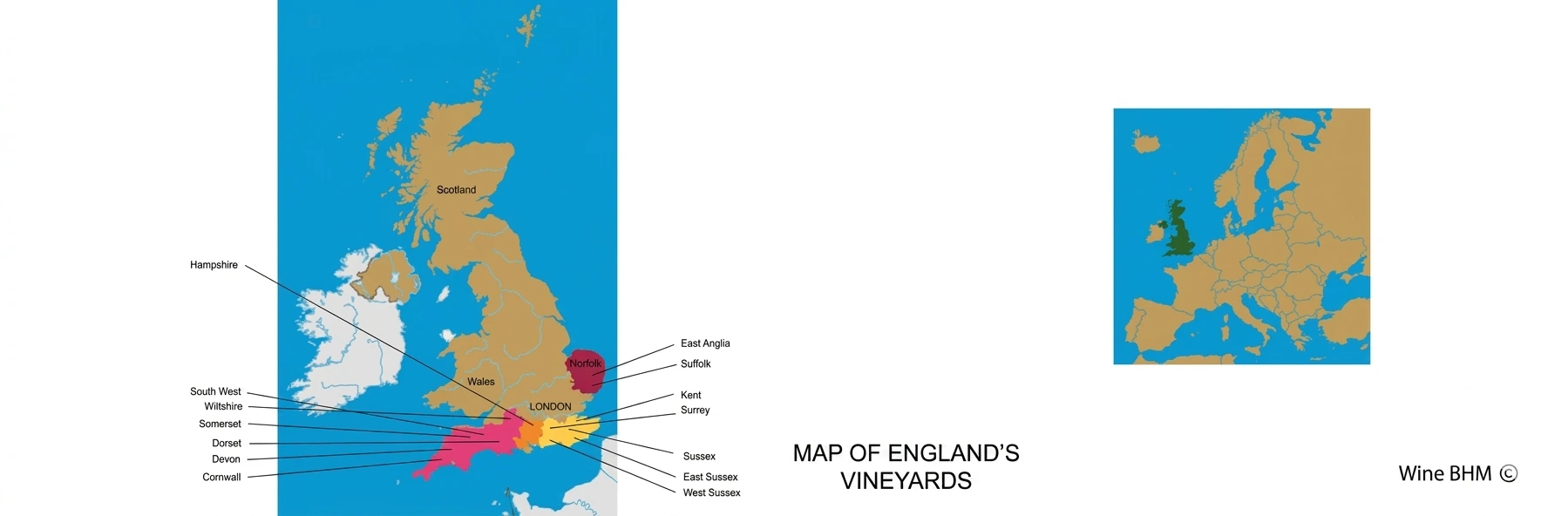
Southeast (Kent, Sussex, Surrey, Hampshire): The heart of English wine — chalk Downs, Greensand, clays. Nyetimber, Ridgeview, Chapel Down, Hambledon. Highest density of premium producers.
East Anglia (Essex, Suffolk, Norfolk): Drier and more continental than the southeast, gravel and clay soils, a growing number of quality producers.
Southwest (Cornwall, Devon, Somerset): Atlantic, warmer but wetter. Growing interest in still wines and early Pinot Noir expressions.
Wales & Midlands: Modest production, hardy hybrid varieties, pioneers of Nordic viticulture.
• Type: Sparkling (Traditional Method)
• Grapes: Chardonnay, Pinot Noir, Pinot Meunier
• Style: The flagship category — increasingly using indigenous yeasts, complex, creamy and beautifully fresh
• Type: Sparkling, Still
• Grapes: Classic sparkling varieties, Bacchus
• Style: England's first county PDO — high quality requirements, national benchmark
• Type: Sparkling, Still
• Grapes: Classic sparkling varieties, Bacchus
• Style: The Garden of England — varied soils, accessible and elegant style
• Type: Sparkling, Still
• Grapes: Classic sparkling varieties
• Style: Chalk and clay — Hambledon, one of England's historic pioneers, produces here
• Type: Still
• Grapes: Bacchus, Pinot Noir, Chardonnay
• Style: England's new frontier — uniquely aromatic Bacchus, Pinot Noir rapidly improving in warm vintages
In cool English conditions, Chardonnay produces wines of exceptional acidity and finesse — ideal as a sparkling base. Warm vintages yield still wines of surprising complexity, with notes of ripe apple, hazelnut and brioche.
Food & wine pairings: Dressed crab, scallops, noble fish, roast chicken.
The primary red grape of English sparkling wines, it also produces increasingly refined still wines — lightness, strawberry, cherry, earthy notes. English sparkling rosés based on Pinot Noir are among the most elegant in the world.
Food & wine pairings: Smoked salmon, duck, game birds, mild cheeses.
England's signature still white grape. A Riesling x Silvaner cross, it produces dry aromatic whites of — elderflower, lime, fresh herbs, white grape notes. Uniquely, immediately identifiable as English.
Food & wine pairings: Seafood, sushi, garden salads, fresh goat's cheese.
Less noble than Pinot Noir but more reliable in cool climates — bringing roundness and fruity notes to sparkling blends. Increasingly vinified as a still wine in leading houses.
Food & wine pairings: Light starters, fine charcuterie, cold poultry.
Nyetimber (West Sussex) — The absolute pioneer, founded 1988. Its Classic Cuvée put England on the global sparkling wine map.
Ridgeview Wine Estate (East Sussex) — Chardonnay-focused sparkling specialist, great consistency, a national reference for 30 years.
Chapel Down (Kent) — England's largest producer, stock exchange-listed, efficiency and accessibility — English wine for everyone.
Hambledon Vineyard (Hampshire) — One of England's oldest commercial vineyards, pure chalk, sparkling wines of aristocratic elegance.
Gusbourne (Kent & West Sussex) — Rapidly ascending reputation, its Blanc de Blancs and Brut Reserve are among the most admired by connoisseurs.
Wiston Estate (West Sussex) — Confidential production, pure chalk vineyards, sparkling wines of remarkable finesse and precision.
Kent and Sussex are 45–75 minutes from London by train — the ideal weekend escape. Preserved English countryside, historic manor houses, centuries-old pubs and vineyard cellars.
Nyetimber Estate in West Sussex is an experience in itself: tastings in a magnificent medieval setting, chalk parcels, English elegance at its finest.
London is the world's wine trading capital — Berry Bros & Rudd (founded 1698), Christie's and Sotheby's wine auctions, one of the most dynamic wine bar scenes in the world.
• Whitstable oysters (Kent) with English Sparkling Wine Blanc de Blancs.
• Dorset dressed crab with dry Sussex Bacchus.
• Scottish smoked salmon with English Chardonnay sparkling.
• Roast grouse (in season, August–December) with still Pinot Noir.
• Traditional afternoon tea with a glass of English rosé sparkling.
Would you like to register your estate or promote it on Wine BHM? Contact us at winebhm.com

Join the selection of producers on the platform.
Join the network*Featured listings are reserved for Pro Premium members, subject to terms and conditions.