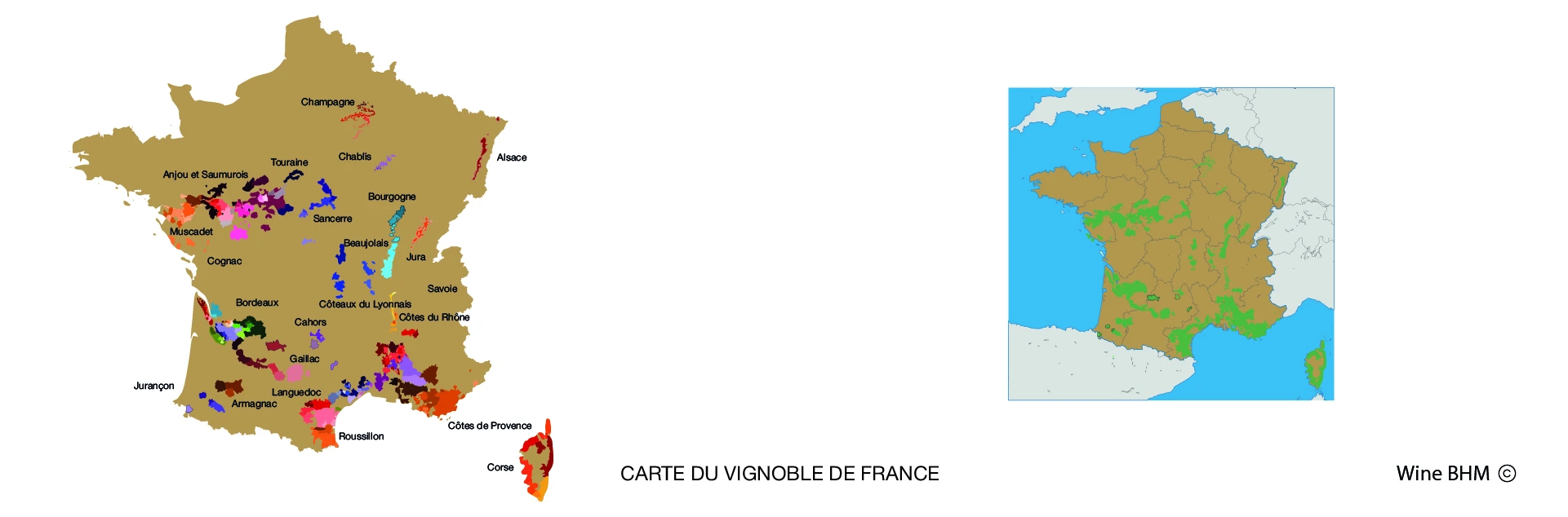
France is, alongside Italy, the world's wine nation par excellence — the number one producer in volume (45.8 million hectolitres in 2023) and the world's leading wine exporter by value (€11.3 billion in 2023). Across approximately 792,000 hectares of vines spread over 80 French departments, it produces an unmatched diversity of wines: from Champagne's sparkling wines to the luscious sweet wines of Sauternes, from Burgundy's Pinot Noirs to the Grenaches of the Languedoc, from Alsatian Rieslings to Loire Valley whites. It is in France that the concept of terroir was born — the conviction that land, climate and the winemaker's hand create irreplaceable wines — and it is around this concept that the entire world has organized its viticulture.
The vine has been cultivated in France since the first Greek trading posts established on the Mediterranean shores in the 7th–6th centuries BC. The Phocaeans — founders of Massalia (Marseille) — introduced vine cultivation to southern Gaul. Under the Roman Empire, vineyards gradually spread northward. In the Middle Ages, Cistercian and Benedictine monasteries developed a precise mapping of the finest terroirs — particularly in Burgundy. Phylloxera (1860–1880) devastated virtually the entire vineyard, which had to be replanted on American rootstocks. The decree-law of 1935 established the Appellation d'Origine Contrôlée (AOC) system, copied across the world, which guarantees the authenticity and traceability of wines. France today counts approximately 59,000 wine-growing operations.
Alsace: 15,600 ha on the foothills of the Vosges mountains — aromatic dry whites (Riesling, Gewurztraminer, Pinot Gris, Muscat), a style unique in France. 51 Grands Crus.
Burgundy: 28,841 ha, 84 AOCs — the world's absolute benchmark for Pinot Noir and Chardonnay. From Chablis to Mâcon, over 600 'Climats' classified as a UNESCO World Heritage Site.
Champagne: 34,300 ha on chalk — the unique birthplace of Champagne. 299 million bottles sold in 2023. Three grapes: Chardonnay, Pinot Noir, Pinot Meunier.
Bordeaux: 110,000 ha — France's largest AOC vineyard, organized around the Gironde, Garonne and Dordogne rivers. Left Bank (Médoc, Graves), Right Bank (Saint-Émilion, Pomerol), Entre-Deux-Mers.
Rhône Valley: From north of Lyon to Avignon — Syrah in the northern Rhône (Hermitage, Côte-Rôtie), Grenache blends in the south (Châteauneuf-du-Pape). One of France's most ancient vineyards.
Loire Valley: France's longest vineyard, from source to estuary — Muscadet, Anjou, Saumur, Touraine, Sancerre, Pouilly-Fumé. Great diversity: dry, off-dry, sweet, sparkling styles.
Languedoc-Roussillon: 246,000 ha — France's largest wine region by area. Mediterranean wines, profound quality revolution since the 2000s.
Provence: The world's leading rosé-producing region — Grenache, Cinsault, Mourvèdre. Bandol (age-worthy reds), Cassis (whites), Provence rosé exported worldwide.
Southwest: Group of regions around Bordeaux and the Pyrenees — Cahors (Malbec), Madiran (Tannat), Jurançon (sweet whites), Bergerac, Gaillac. Unique indigenous grape varieties.
Alsace, Jura, Savoy, Corsica: Mountain and island regions of strong character — Jura's Vin Jaune (Savagnin), Savoy's Roussette and Jacquère, Corsica's Nielluccio and Vermentino.
Type: Sparkling
Grapes: Chardonnay, Pinot Noir, Pinot Meunier
Style: Traditional method, Brut, Extra-Brut, Blanc de Blancs, Vintage — the world reference for sparkling wine
Type: Red, White, Sweet
Grapes: Cabernet Sauvignon, Merlot, Cabernet Franc, Sauvignon Blanc, Sémillon
Style: From the Médoc Classified Growths to Pomerol's velvety reds — the greatest diversity in a single vineyard
Type: Red, White
Grapes: Pinot Noir, Chardonnay
Style: Four-level hierarchy (regional, village, Premier Cru, Grand Cru) — complexity in its purest form
Type: White
Grapes: Chardonnay
Style: Mineral dry white on Kimmeridgian limestone — the world benchmark for dry, unoaked Chardonnay
Type: White, Red
Grapes: Sauvignon Blanc, Pinot Noir
Style: World-benchmark dry Sauvignons on flint and limestone in the Loire Valley
Type: Red, White
Grapes: Syrah, Grenache, Viognier, Marsanne
Style: Great granite Syrahs of the north, powerful southern blends — the Rhône in all its majesty
Type: White, Sparkling
Grapes: Riesling, Gewurztraminer, Pinot Gris, Muscat, Pinot Blanc
Style: Uniquely aromatic dry whites, 51 Grands Crus, quality Crémant d'Alsace
Type: Sweet
Grapes: Sémillon, Sauvignon Blanc, Muscadelle
Style: Botrytis cinerea — the world's greatest sweet wines, led by Château d'Yquem
The king grape of the Médoc and Bordeaux's left bank. Notes of blackcurrant, cedar, graphite, herbs. Powerful tannins, great longevity. The greatest Médocs often need 10 to 20 years of cellaring to reveal their full complexity.
Food & wine pairings: Roast lamb, rib-eye steak, pressed cooked cheeses, game.
France's most planted grape variety. Fruity, round, silky — bringing suppleness and accessibility to Bordeaux blends. On the right bank clays (Saint-Émilion, Pomerol), it achieves exceptional depth and concentration.
Food & wine pairings: Roast poultry, veal, braised meats, mild cheeses.
Burgundy's great grape — delicate, demanding, irreplaceable. Notes of cherry, strawberry, raspberry in youth; undergrowth, spice, truffle with age. The Grand Crus of Gevrey-Chambertin and Vosne-Romanée are among the world's most admired and expensive wines.
Food & wine pairings: Chicken with morel mushrooms, duck, game, Burgundy cheeses (Époisses, Cîteaux).
Burgundy's and Champagne's great white grape. In Chablis, it is dry and mineral. In the Côte de Beaune (Meursault, Puligny-Montrachet), it develops hazelnut, butter, citrus and incomparable depth. In Champagne, the backbone of Blanc de Blancs.
Food & wine pairings: Noble fish, seafood, scallops, cream-sauced poultry, truffle.
In Sancerre and Pouilly-Fumé, it reaches its purest expression — boxwood, citrus, flint, characteristic smoky notes. In Sauternes, it completes Sémillon in the great sweet wines.
Food & wine pairings: Goat's cheeses, seafood, asparagus, spring salads.
In Côte-Rôtie and Hermitage, it produces black, concentrated wines with aromas of violet, black olive, pepper, smoked meat — among the world's greatest red wines. In the Languedoc and southern Rhône, it features in warm and spiced blends.
Food & wine pairings: Game, grilled meats, strong cheeses, lamb cutlets.
Domaine de la Romanée-Conti (Burgundy) — The world's most mythical and most expensive estate — La Romanée-Conti, La Tâche, Richebourg, Montrachet. An absolute benchmark.
Château Pétrus (Pomerol) — Bordeaux's most expensive wine, vinified almost entirely from Merlot on unique blue clay. Confidential production, infinite worldwide demand.
Château d'Yquem (Sauternes) — The only Premier Cru Supérieur of Sauternes — the world's greatest sweet wine, vintage after vintage for centuries.
Krug (Champagne) — The most admired Champagne house among connoisseurs. Grande Cuvée and Clos du Mesnil at the summit of the Champagne art.
Jean-Louis Chave (Hermitage) — The absolute reference for northern Syrah — his red and white Hermitage are monuments of French wine.
Domaine Zind-Humbrecht (Alsace) — Pioneer of biodynamics in Alsace, Grand Cru Rieslings and Gewurztraminers among the most admired in the world.
Henri Bourgeois (Sancerre) — The reference for Loire Sauvignon Blanc — Sancerre of exemplary precision and minerality for several generations.
Château Rayas (Châteauneuf-du-Pape) — The most sought-after Châteauneuf — confidential production, pure Grenache, rare elegance in the southern Rhône.
France is the world's top tourist destination, and wine is an essential part of it. Each region offers its unique experience: Loire Valley troglodyte caves, Burgundy's UNESCO-listed Grands Crus road, Bordeaux château hotels, and tastings in Épernay's Champagne cellars carved into chalk.
Saint-Émilion, a UNESCO World Heritage Site, is one of Europe's most beautiful wine villages — vines growing up to medieval doorsteps, underground caves and exceptional gastronomic tables.
Burgundy's Route des Grands Crus between Dijon and Beaune concentrates within 60 km the most mythical names in world wine — Gevrey-Chambertin, Vougeot, Vosne-Romanée, Meursault, Puligny-Montrachet. An unmissable pilgrimage for any serious wine lover.
• Brittany or Marennes-Oléron oysters with Muscadet Sur Lie or Chablis Premier Cru.
• Duck foie gras with Sauternes or Alsatian Gewurztraminer Vendanges Tardives.
• Bœuf bourguignon with a Gevrey-Chambertin Village.
• Marseille bouillabaisse with a Cassis white or a Palette white.
• French cheese board (Comté, Époisses, Munster) with a Burgundy Pinot Noir.
• Tarte Tatin with a moelleux Vouvray or a Coteaux du Layon.
Would you like to register your estate or promote it on Wine BHM? Contact us at winebhm.com
Join the selection of producers on the platform.
Join the network*Featured listings are reserved for Pro Premium members, subject to terms and conditions.