The UnitedStates is the world's fourth-largest wine producer and its largest consumer market. A country of excess and innovation, America shook the established world wine order in 1976 at the legendary 'Judgment of Paris,' where California Cabernet Sauvignon and Chardonnay blindly outscored the greatest crus of Bordeaux and Burgundy. Since then, American viticulture has branched into all fifty states with unmatched creativity, ambition and investment capacity. From Napa Valley to Oregon and Washington State, the United States now produces some of the most sought-after — and most expensive — wines in the world.
Vines were planted by European settlers as early as the 17th century. Commercial viticulture organized itself around California following the Gold Rush (1849). Prohibition (1920–1933) devastated the industry for thirteen years. The renaissance was slow but spectacular: the Judgment of Paris (1976) placed California on the world map. The AVA (American Viticultural Areas) system, created in 1983, now designates over 260 geographic regions without restricting grape varieties or production methods — a fundamental freedom of American wine philosophy.
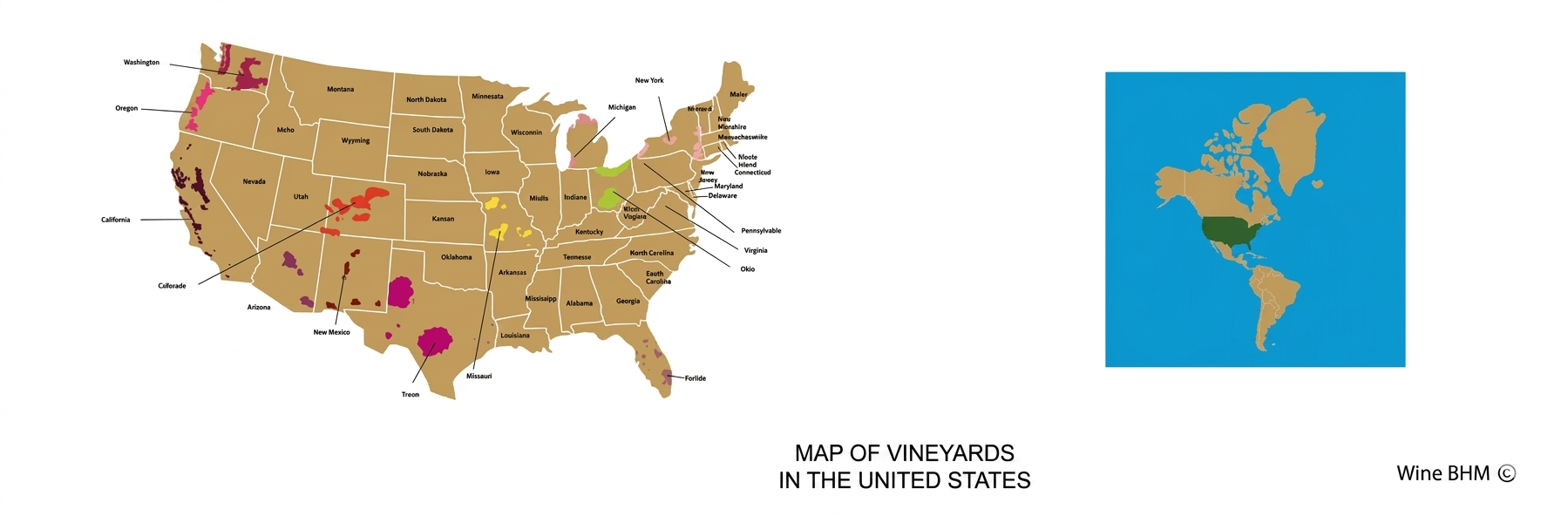
California: 85% of national production. Napa Valley (iconic Cabernet Sauvignon), Sonoma County (artisanal diversity), Central Coast (Pinot Noir, Chardonnay), Sierra Foothills (old-vine Zinfandel).
Oregon: The Willamette Valley is America's Burgundian Pinot Noir sanctuary. Cool climate, volcanic soils, passionate producers.
Washington State: Semi-arid Columbia Valley — irrigated from the Columbia River. First-rate Cabernet Sauvignon, Merlot, Riesling and Syrah.
New York: Finger Lakes (Germanic Rieslings), Long Island (maritime influence, Bordeaux varieties), Hudson Valley (artisanal producers).
Emerging Regions: Texas Hill Country, Virginia, Michigan, Colorado — rapidly growing regions developing distinct viticultural identities.
• Type: Red, White
• Grapes: Cabernet Sauvignon, Merlot, Chardonnay
• Style: America's wine Olympus — 16 sub-AVAs, powerful and silky reds, opulent whites, global premium pricing
• Type: Red, White
• Grapes: Pinot Noir, Chardonnay
• Style: Pacific fog influence, elegant and complex Pinot Noir, mineral Chardonnay
• Type: Red, White
• Grapes: Pinot Noir, Chardonnay, Syrah
• Style: Ocean-influenced, wines of Burgundian finesse and complexity
• Type: Red, White
• Grapes: Pinot Noir, Pinot Gris, Chardonnay
• Style: Oregon's Burgundian Pinot Noir — 6 sub-AVAs, volcanic soils, vibrant acidity
• Type: Red, White
• Grapes: Cabernet Sauvignon, Merlot, Riesling, Syrah
• Style: Semi-arid, strong diurnal temperature swings, concentrated reds and precise aromatic whites
• Type: Red, White
• Grapes: Cabernet Sauvignon, Zinfandel, Grenache, Syrah
• Style: Rhône Rangers country, old-vine Zinfandel, powerful and warming reds
• Type: White, Red
• Grapes: Riesling, Chardonnay, Cabernet Franc
• Style: Remarkably precise Rieslings of Germanic style, steely acidity, great aging potential
The king of Napa Valley. In California, it expresses blackcurrant, cedar, graphite and chocolate notes with silky tannins wrapped in solar ripeness. The great Napa Cabs (Opus One, Harlan, Screaming Eagle) are among the world's most expensive wines.
Food & wine pairings: Rib-eye steak, lamb, hard cheeses, grilled meats.
In Oregon's Willamette Valley, it produces wines of Burgundian delicacy — strawberry, cherry, forest floor, gentle spice. In California (Russian River, Sonoma Coast), it gains richness and depth while retaining beautiful acidity.
Food & wine pairings: Wild Pacific salmon, roast duck, wild mushrooms, charcuterie.
From the over-oaked styles of the 1980s–90s, California producers have moved to finer, more precise expressions. In Oregon, it shows a minerality and acidity close to Burgundy.
Food & wine pairings: Lobster, scallops, roast chicken with cream sauce, noble fish.
Truly America's wine (Croatian in origin, but adopted as a national signature). Exuberant blackberry and jam fruitiness, peppery notes, generous alcohol. Old-vine Zinfandels from Dry Creek and Sonoma County are monuments of character.
Food & wine pairings: American BBQ, ribs, pizza, spiced charcuterie.
Opus One (Napa Valley) — Legendary Robert Mondavi / Baron Philippe de Rothschild joint venture — the first Napa wine to conquerthe world.
Screaming Eagle (Napa Valley) — Absolute cult status — confidential production, years-long waiting list, astronomical secondary market prices.
Domaine Drouhin Oregon — Burgundy transplanted to Oregon — Joseph Drouhin's know-how in the Willamette Valley with astonishing results.
Ridge Vineyards (Santa Cruz Mountains) — Temple of California Zinfandel and Cabernet. Monte Bello has been among America's most admired reds since the 1970s.
Cayuse Vineyards (Walla Walla) — Biodynamic Washington, breathtaking cobblestone-soil Syrah — Cailloux and Camaspelo are global benchmarks.
Kosta Browne (Sonoma) — Modern California Pinot Noir of impeccable consistency — eagerly awaited by collectors worldwide.
Napa Valley is the world's most sophisticated wine tourism destination. The French Laundry (Thomas Keller), Meadowood, vineyard spas, cave hotels — unrelenting luxury 90 minutes from San Francisco.
Sonoma County offers the flip side of Napa — more rural, more artisanal, more authentic. Farmers markets, craft breweries, passionate winemakers welcoming you directly into their cellars.
Portland & Willamette Valley: America's most food-forward city just 30 minutes from Oregon's vineyards — an unbeatable combination.
• Maine lobster or Dungeness crab with Russian River Chardonnay.
• Grilled prime rib with Napa Valley Cabernet Sauvignon.
• Wild Pacific salmon with Oregon Pinot Noir.
• American BBQ (ribs, brisket) with Dry Creek Valley Zinfandel.
• Artisan California cheese board with Oregon Pinot Gris.
Would you like to register your estate or promote it on Wine BHM? Contact us at winebhm.com
Join the selection of producers on the platform.
Join the network*Featured listings are reserved for Pro Premium members, subject to terms and conditions.