Frédéric Lot
Editorialiste pour Wine BHM
“The field awakens, challenges, and enlightens us, and we must make the most of its potential.” M. Rolland
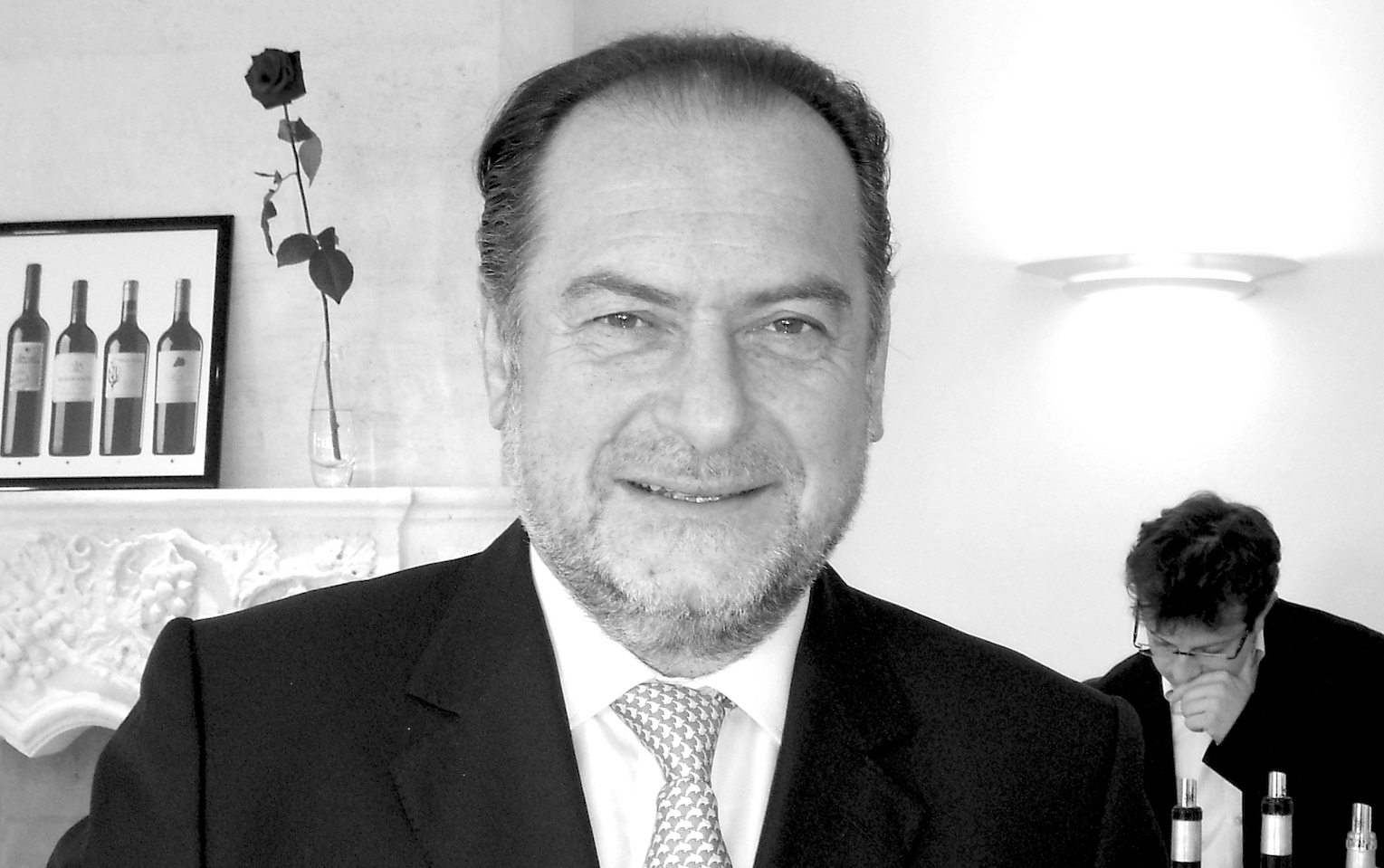
W ith his sudden passing at the age of 78, just as spring was beginning, the Libourne-based oenologist Michel Rolland leaves a huge void within the wine community. Through the inspiring journey of this figure who never failed to make an impression—his boldness, his vision, his omnipresence, his versatile intelligence, and his pivotal contribution to Bordeaux and international winemaking—Michel Rolland will forever remain the iconic figure who pushed the Bordeaux wine region (and beyond) out of its comfort zone.
Learning of Michel Rolland’s passing has come as a profound shock. On March 20, 2026, the initial stunned disbelief and bewilderment at a life cut short in its prime—Michel was only 78 years old and had 52 Bordeaux vintages to his credit—have given way to a period of acceptance and the need to pay our respects. Michel Rolland’s international presence in the wine and spirits industry, on this wine journey he navigated at full speed throughout his life, has triggered an avalanche of tributes.
The wine consultant, far more down-to-earth than his reputation as a “flying winemaker” might suggest, is bowing out of the international wine scene far too soon. The winemaker (Michel truly was one) and the most iconic wine consultant of his generation—world-renowned and a fervent advocate of a more “modern” approach to winemaking, which he would go on to reinvent over the course of a career spanning more than fifty years—has joined other illustrious figures in the wine hall of fame. With his passing, this workaholic who lived life at a breakneck pace—he who lived life in the fast lane—now leaves behind, in his masterful body of work, a sense of unfinished business.
Many of us gathered to pay our final respects to him on Friday, March 27, in his hometown. A dense crowd quickly filled the small Saint Jean de Pomerol church to attend a moving ceremony led by Dominican Father Corentin Pezet. Through the nature of his funeral, Michel proved right to the end that he had been, throughout his life, a leader, a unifier, and a catalyst for all the positive energy of the wine world.
A pivotal and seminal chapter in a particular approach to wine—one defined by his immense contribution—is coming to a close. But these pages, penned by this novelist of wine and inspired by the pivotal actions of the great oenologist he was in his relentless pursuit of excellence in the grape (and thus in fine wine), constitute a major chapter that Michel’s unexpected departure cannot bring to a close. No! Despite appearances, Michel didn’t bang the clapperboard. His departure is neither a “wrap” nor a sign that all the scenes have been wrapped up: other shoots still need to be completed. The film isn’t finished. Michel’s methodological approach (his legacy) is just waiting to be expanded infinitely. In this particular instance, it’s hard not to immediately think of agricultural engineer Julien Viaud (and his teams). This long-time colleague of Michel and Dany at the Rolland & Conseils laboratory—who has been working with them since 2006—has the family’s complete trust. The same is true for two other colleagues at the Catusseau site. While this new generation brings fresh energy, it’s worth noting that Michel has never lacked it throughout his career. But new challenges await these winemaking consultants. And while oenology must constantly reinvent itself, Rolland & Conseils will never stray from the immutable principle established and championed by Michel. A founding principle that is one of Michel’s hallmarks and which immediately positioned him at the forefront of modernity: his axiom of the proper ripeness of grapes with healthy, ripe berries.
To facilitate this transition within the laboratory (which became Rolland & Associés in May 2020), Dany, Michel, and Stéphanie Rolland sold 60% of their shares to Jean-Philippe Fort, Julien Viaud, and Mikael Laizet (three of the laboratory’s closest collaborators, whose signatures appear on more than 200 wines featured each year in Les Clés de châteaux). The transfer of the “Rolland method” and the handover (covering technical expertise, client file management, and laboratory operations) had thus already been firmly established. Since then, Stéphanie (the Rollands’ eldest daughter, who also serves as administrative and financial director) and Julien Viaud have jointly managed the flagship operation. In 2020, Michel had indeed expressed a desire to step back slightly, while still wishing to remain personally involved in several properties in Bordeaux, the United States, and South America.
Today, while Michel’s absence remains a gaping wound that is far from having begun to heal, looking toward the future shows us that the inspiring and fascinating story of viticulture and the science of wine—in Bordeaux and around the world—is far from over. It will continue to unfold as production and marketing rise to ever greater challenges. These challenges lie both in the operational realm (the digitization of the sector), in the economic realm (emerging from the crisis, regaining ground, acquiring new markets, and rekindling consumers’ desire to drink wine), and finally, more than ever, on environmental issues (solutions for coping with global warming while fighting to preserve the future of terroir identity and the unique expression of each wine’s place of origin).
Who was Michel Rolland? An exceptional taster, a tasting marathon runner with a memory that commanded respect. Michel was to oenology (and wine consulting) what Truffaut, Godard, and Agnès Varda were to cinema: the architect of a “New Wave” in oenology. ” With him, the science of wine reveals itself to be bold, innovative, unpretentious, tangible, and truly practical. Michel is a man of the earth—let’s not forget that! His oenological approach is therefore down-to-earth, stripping wine science of its often abstruse language and all embellishments, resulting—much like the aforementioned cinematic genre—in a divisive approach that breaks the rules. Michel literally shook up mindsets, not without ruffling a few feathers along the way. By significantly shifting the boundaries—as no one before him had done—Michel Rolland awakened the wine world’s consciousness, a task that was by no means simple. Michel embodied the spirit of “Never give up!”
To fully understand the situation, let’s go back to the context of the 1970s and 1980s. Until the mid-1980s, the wine world was still somewhat rigid, rather rustic, and outdated. It was an environment “outdated” in its practices and old habits that were still in vogue. One of these is telling: aging in old barrels, which obviously imparted off-flavors, with the added consequence of inconsistent hygiene in the fermentation tanks and cellars. There was also the issue of production: yields in the vineyard were too high, very often because nature could be generous (depending on the year), sometimes too much so. The result was diluted juice (we didn’t yet speak of concentration, nor of “green harvesting”). Michel would later advocate this novel practice, which many viewed as uneconomical (though not for long), as removing half or a third of the grapes in July (“green harvesting”)—to reduce the crop load—must have caused quite a stir among the vine rows. As for the harvest, the grapes were picked far too early, likely out of fear of rainfall—including the equinox rains (as autumn approached)—and because people had long forgotten or ignored the fact that perfectly ripe grapes are the foundation for producing good wines. In this regard, Michel didn’t beat around the bush—and thank goodness for that. The grapes, most often harvested by hand and in small crates, have gained in precision, in alcohol content (the climate isn’t the only factor; increased leaf area also plays a role), and finally in aromatic freshness. The wines now shine with greater brilliance in the glass. Before Michel, the harvest reception process was a nightmare for the grapes, as pumping through long hoses compromised the integrity of the berries. And double sorting—in the vineyard and on the sorting table (by density or optical means)—was not part of the routine.
As for winemaking, fermentation control was far from perfect—in fact, it was rarely adequate. It was not uncommon for fermentation to stall midway through the process in the tanks (since the sugars were not fully broken down by the yeast), resulting in the presence of problematic volatile acids. Back then, reversible hot-cold temperature control wasn’t even a thing. Michel was the very first to have this system installed and put it into use in 1987 at Le Bon Pasteur, before suggesting its widespread adoption to his clients.
As for the wines, the profiles obtained left little room for the complexity of the grape varieties to shine through once blended, due to the complete lack of plot-by-plot selection. Vinification took place in huge concrete, stainless steel, or occasionally wooden tanks, with capacities ranging from 150 to 200, or even 250 hectoliters. The time had not yet come for batch vinification in “small” stainless steel or wooden tanks (40 to 50 hl), nor for aging different batches in barrels (though this is very useful for effectively blending the disparate characteristics of the plots and finding the best expression of the grape varieties, depending on the unique character of each vintage). Let’s not forget that Michel also revolutionized winemaking by introducing “whole-cluster” vinification in new barrels. Inspired by Burgundian methods, it was at Le Bon Pasteur, in 2008 I believe, that he first used the process. Michel must have recommended it, I imagine, as early as 2002: I remember seeing the process in action in October 2002, in his presence, at Alain Raynaud’s in Quinault L’Enclos. This winemaking method, which was very new in Bordeaux, involved initiating alcoholic fermentation after about six days of low-temperature maceration, all under a blanket of carbon dioxide (a striking sight!). The barrels, which had been specially modified for this process—specifically in terms of the bung, the bunghole, and the bottom—were rotated every three hours on “Oxoline” rotating racks. The rotation of barrels on rollers was a process invented by the Baron cooperage that same year, which increased storage capacity in the cellars by nearly 65%. Quite an achievement! I found the entire process and the handling of these barrels to be innovative, unprecedented, and inspiring. Michel, ever the experimenter at every stage of winemaking, was likely no stranger to all these advancements.
Finally, regarding the art of letting the terroir speak through blending, Michel literally put the church back in the center of the village. With him, blending—whether it involves combining multiple grape varieties or single-varietal wines from different climats or soil profiles—became a vital prerequisite for ensuring both the signature and the uniqueness of a vintage.
All the bad habits mentioned—which Michel helped gradually consign to the Stone Age—are above all a reflection of a time when, for a long time, people relied on the white coats (the oenologists) to let oenology try to fix what wasn’t right, with its accompanying rampant chaptalization to try to boost the alcohol content. It was a different era, fortunately now a thing of the past given the ripeness of the grapes achieved since the 2000s—once again, whether due to actual global warming or not: that is another debate. But here’s the thing! Remedial measures have their limits. What nature does not provide cannot be compensated for. Bordeaux could have faced many more lean years (much like the terrible 1970s, which lasted until 1980, with the possible exception of the 1970 vintage and, to a lesser extent, 1978) if, on the one hand, oenology had remained confined to the use of medications and antibiotics without considering a fundamental overhaul of part of its model; and if, on the other hand, the estates had refused to radically rethink their practices, despite the advice of Michel or other consultant winemakers following in his footsteps.
Despite his virtuosity, experience, expertise, and ability to communicate his knowledge, Michel was neither narrow-minded nor averse to questioning himself when the situation called for it. According to the technical teams at the estates who placed their complete trust in him throughout his career, Michel took everyone’s perspectives and sensibilities into account, demonstrating a willingness to listen even when he had carte blanche. Michel was therefore neither a conqueror nor a taste inquisitor, whatever the angry gossipmongers might say.
Just like the technical staff at his clients’ estates, Michel was highly regarded by his clients for his ability to unite them in their efforts to produce great wines. On this subject, the late Daniel Cathiard (another leading figure in the Bordeaux region who passed away on January 28, 2026) once said of him: “Michel gives us the confidence to dare and go further in expressing the very best within us and in our vineyards.” Michel excelled in the art of drawing out ideas, practicing a form of Socratic maieutics among the producers.
Every new client, every terroir explored, every wine-producing country visited by this tireless traveler and explorer of wine regions—he always set out with boundless enthusiasm to take on every challenge, wherever he was called upon. Where? Well, as we’ve seen, everywhere. Michel’s influence and reputation were surrounded by an aura that no one could dispute.
In Pomerol, Libourne, Saint-Émilion, and even Bordeaux, Michel would undoubtedly deserve to have a street named after him. We can remember Michel as the architect of major scientific, technical, and technological advancements that have left a lasting and irreversible mark on oenology and viticulture. Advances that continue to nourish Bordeaux and global viticulture today—and will do so tomorrow. But let us keep in mind that he was first and foremost a formidable experimenter, a genius inventor, and a progressive driven by his open-mindedness and his versatile intelligence. In modernizing his profession—a transformation he spearheaded—Michel lived for his unwavering passion for wine, never looking back. Brimming with projects, and surely regretting none of his choices, always on the lookout for new challenges, Michel loved nature, the land, and life above all else. He never let it consume him; on the contrary, he chose to embrace it fully without sacrificing his family, the true cornerstone of his balance. Michel always remained in control of his own life.
His legacy, as deep-rooted as that of old Merlot vines or venerable Malbecs, is now embodied in his daughters, his grandchildren (under Dany’s watchful and caring eye), and his colleagues at Rolland & Associés. May it also endure for future generations to keep the Rolland spirit alive. And for all those whose lives he touched—both personally and professionally—and there are many of us, let us pay tribute to him by regularly raising a glass (in moderation) to his health, while savoring the wines he crafted!
Photo credit: Frederic LOT
March 27, 2026
Frédéric Lot
Editorialiste pour Wine BHM
Join the selection of producers on the platform.
Join the network*Featured listings are reserved for Pro Premium members, subject to terms and conditions.