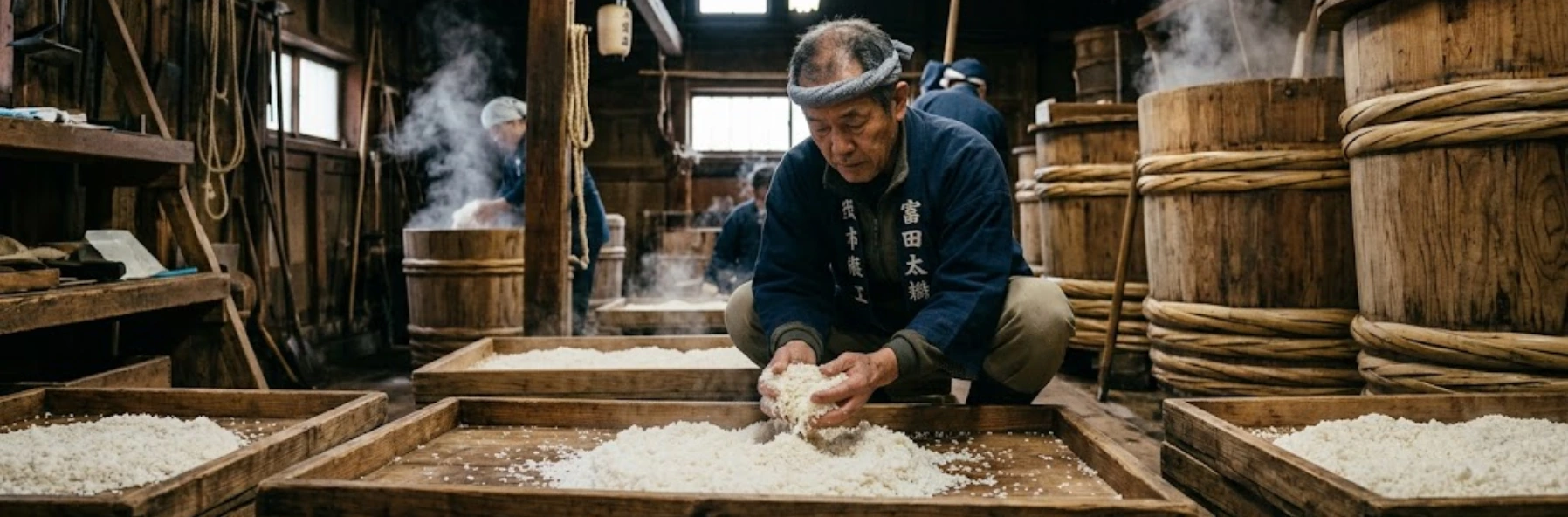
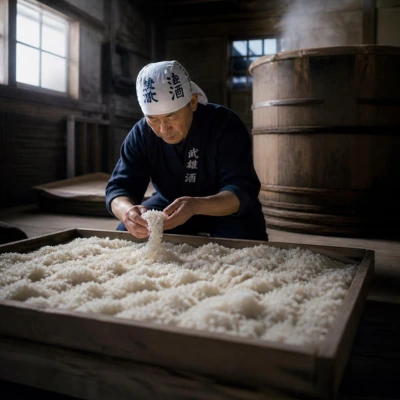
A sake producer, called toji in Japan, is a master brewer specialising in the elaboration of sake, an alcoholic beverage obtained by the fermentation of polished rice using a fungus called Aspergillus oryzae (koji) and selected yeasts. Sake is often incorrectly called "rice wine" but its production method is closer to beer brewing than winemaking.
The toji masters an exceptional know-how combining knowledge of rice, koji, water and yeasts in a parallel fermentation process unique in the world. Sake production is a millennia-old Japanese tradition, deeply linked to culture, Shinto religion and Japanese gastronomy.
Sake has been brewed in Japan for over 2,000 years. The earliest written mentions date back to the Kojiki (712 AD), the oldest book in Japanese history. Originally, sake was produced in Shinto temples as an offering to the deities, then progressively diffused throughout Japanese society.
It was in the 14th century that the first commercial breweries, the sakagura, appeared around the temples of Nara and Kyoto. The technique of rice polishing was progressively refined, making it possible to obtain increasingly pure and refined sakes. Pasteurisation, invented in Japan by Hirose Tazaemon in the 16th century — three centuries before Pasteur — contributed to the preservation and distribution of sake.
In the 20th century, sake production progressively declined in favour of beer and whisky, but since the 2000s sake has experienced a spectacular revival, particularly thanks to its international expansion. Today sakagura are being created outside Japan, in France, the United States, Australia and Spain.
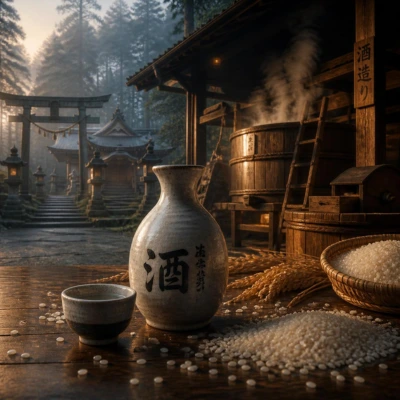
Sake production begins with rice polishing. The polishing ratio, expressed as a percentage of remaining rice, is decisive for the quality and style of the sake: the more the rice is polished, the finer and more delicate the sake. A Daiginjo is polished to less than 50%, meaning more than half of the grain is removed.
The polished rice is then washed, soaked, steamed and then inoculated with koji, a fungus that transforms starch into fermentable sugars. This is the most delicate and most decisive step for the final aromatic profile. The parallel fermentation process, where saccharification and alcoholic fermentation take place simultaneously in the same tank, is a unique specificity of sake.
After fermentation, the sake is pressed, filtered, pasteurised (except for namazake, raw sake) and bottled. Some sakes are diluted with water to reach the desired alcohol content, while others, called genshu, are bottled at full strength.
According to data from the Japan Sake and Shochu Makers Association:
Over 1,500 sakagura (sake breweries) active in Japan — Japan Sake and Shochu Makers Association
Approximately 500,000 kilolitres of sake produced in Japan each year — National Tax Agency Japan
Sake exports reached a record 14.8 billion yen in 2022 — Japan Sake and Shochu Makers Association
Over 50 countries import Japanese sake — Japan Sake and Shochu Makers Association
Around thirty sakagura now operate outside Japan, in 10 different countries
Junmai — pure rice sake, no added alcohol, pronounced umami profile, can be served warm or cold
Ginjo — rice polished to less than 60%, low-temperature fermentation, fruity and floral aromas
Daiginjo — rice polished to less than 50%, prestige sake, complex and delicate aromas
Honjozo — small addition of distilled alcohol to refine aromas, light and accessible style
Namazake — unpasteurised sake, fresh and lively, must be kept cold, quick consumption
Nigori — cloudy sake, partially filtered, creamy texture, pronounced rice notes
Koshu — aged sake, amber colour, nut and caramel aromas, rare and sought-after
Sparkling Sake — effervescent sake, emerging trend, festive and accessible style
Genshu — undiluted sake, high alcohol content (18-20%), maximum aromatic intensity
Kimoto / Yamahai — traditional starter preparation methods, natural acidity, complex character
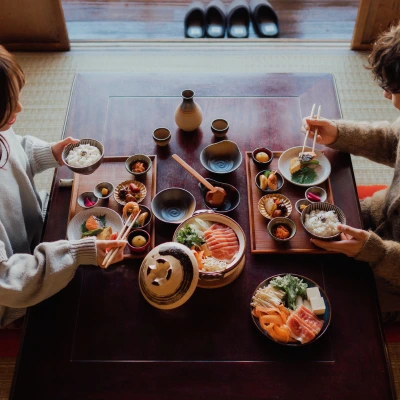
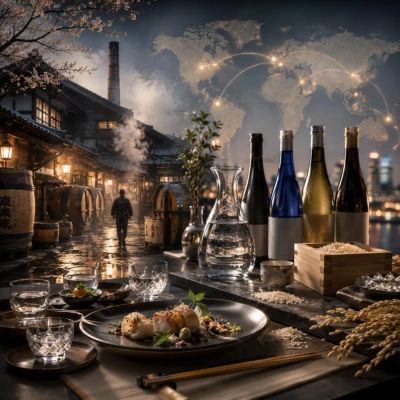
Sake faces a major paradox in Japan: domestic consumption has been declining steadily since the 1970s, while exports are reaching historical records. This situation pushes sakagura to innovate, communicate differently and develop new markets internationally, particularly in Europe, the United States and South-East Asia.
The emergence of sake outside Japan is a strong trend. French, American, Australian and Spanish sakagura now produce quality sakes with local rice and local water, creating new terroir expressions that enrich the diversity of this millennial beverage.
Finally, the international gastronomic recognition of sake is progressing rapidly. More and more Michelin-starred chefs outside Japan are proposing sake pairings, helping to introduce it to a wider and more discerning audience.
Dassai – Asahi Shuzo — Yamaguchi, Japan
Gekkeikan — Fushimi, Kyoto, Japan
Hakutsuru — Nada, Hyogo, Japan
Ozeki — Nada, Hyogo, Japan
Dewazakura — Tendo, Yamagata, Japan
Kubota – Asahi Shuzo — Niigata, Japan
Born – Katayama Shuzo — Fukui, Japan
Tentaka Sake — Tochigi, Japan
Kikusui Sake — Niigata, Japan
Hakkaisan — Niigata, Japan
Masumi – Miyasaka Jozo — Nagano, Japan
Urakasumi – Saura — Miyagi, Japan
Denshin – Ippongi Kubohonten — Fukui, Japan
Konteki – Tsuruno Sato — Fushimi, Kyoto, Japan
Kirinzan — Niigata, Japan
Joto Sake — Kagawa, Japan
Imanishiki – Shata Shuzo — Nagano, Japan
Tamanishiki — Hiroshima, Japan
Sake One — Forest Grove, Oregon, USA
Brooklyn Kura — Brooklyn, New York, USA
Wakaze — Poissy, France / Tokyo, Japan
Musashino Sake — Saitama, Japan
Nishi Nishiki — Yamaguchi, Japan
Miyasaka – Grace Omachi — Nagano, Japan
Mioya Shuzo — Ishikawa, Japan
Umenishiki — Ehime, Japan
Would you like your company to appear on this page? Listings are reserved for Pro Premium members of Wine BHM.
Join the selection of producers on the platform.
Join the network*Featured listings are reserved for Pro Premium members, subject to terms and conditions.