Germany is Europe's great misunderstood wine nation — too long reduced to its mass-exported sweet wines, it is in reality the homeland of Riesling in its most sublime expressions. Cultivated on near-vertical slate slopes of the Mosel under extreme conditions of cold and light, German Riesling achieves a complexity, precision and longevity unmatched anywhere else in the world. The ongoing revolution — led by a new generation within the VDP (Verband Deutscher Prädikatsweingüter) — has restored Germany to the place it should never have left: among the world's very finest wine regions.
German viticulture dates back to the Romans along the Rhine and Mosel rivers. Cistercian monks at Kloster Eberbach (Rheingau, 12th century) developed a terroir mapping of remarkable precision that prefigured the Burgundian Grand Cru concept. In the 19th century, at major auction sales, Mosel and Rhine Rieslings commanded higher prices than Bordeaux first growths. The 1971 wine law unfortunately simplified and levelled the classification system, but the VDP's reforms since the 1990s have restored the nobility of the finest vineyards.
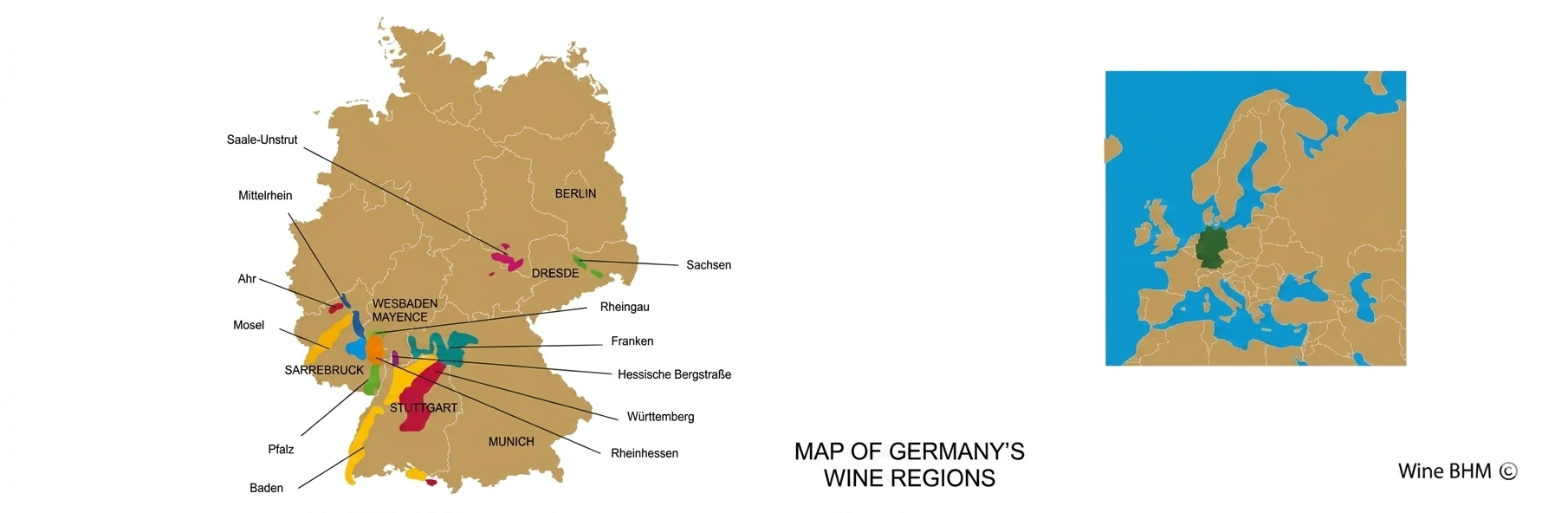
Mosel (with Saar and Ruwer): Blue and grey slate, near-vertical slopes — Riesling of crystalline delicacy and unique minerality. Bernkasteler Doctor and Wehlener Sonnenuhr are among the world's greatest individual vineyards.
Rheingau: South-facing stretch of the Rhine — Riesling of body and nobility, aristocratic estate tradition, and excellent Spätburgunder in the hills.
Rheinhessen: Germany's largest wine region in full quality renaissance — Riesling, Silvaner, Weissburgunder, and some of the country's most talented young winemakers.
Pfalz (Palatinate): Warm, prolific region — powerful Riesling, fleshy Spätburgunder, great diversity of styles.
Baden: Germany's southernmost, warmest region — Burgundian-style Spätburgunder, Chardonnay, strong Alsatian influence.
Franken (Franconia): Distinctive Bocksbeutel stone-jug bottles — earthy and mineral Silvaner on limestone, authentic and terroir-driven.
• Type: White (dry to off-dry)
• Grapes: Riesling, Silvaner, Müller-Thurgau
• Style: The lightest Prädikat level — elegant, low-alcohol, delicate finesse, ideal at table
• Type: White (dry to sweet)
• Grapes: Riesling dominant
• Style: Late harvest, more ripeness and intensity — dry style (trocken) is particularly gastronomic
• Type: White (off-dry to sweet)
• Grapes: Riesling, Gewürztraminer, Grauburgunder
• Style: Selected harvest of very ripe bunches, often botrytis-influenced — complex, luscious, great aging potential
• Type: White (luscious)
• Grapes: Riesling, Scheurebe
• Style: Individually berry-selected — sumptuous dessert wines, extremely rare production
• Type: White (luscious)
• Grapes: Riesling
• Style: Individually selected desiccated botrytized berries — among the world's rarest and greatest wines, near-immortal acidity
• Type: White (luscious)
• Grapes: Riesling, Vidal
• Style: Grapes naturally frozen at -7/-8°C — extreme concentration, electrifying freshness
• Type: White dry
• Grapes: Riesling, Spätburgunder
• Style: VDP classification — dry wines from the finest Grand Cru-equivalent vineyards, powerful and profound
The world's greatest Riesling is born in Germany. On Mosel blue slate, it is of crystalline lightness and minerality — lemon, peach, flowers. In the Rheingau, it gains body and nobility. With time, all great Rieslings develop extraordinary complexity of petrol, honey and spice. Some age 50 years and more.
Food & wine pairings: Noble fish, shellfish, sauerkraut, Asian cuisine, powerful cheeses (Munster).
Germany produces some of the finest Pinot Noir outside Burgundy. In Baden and the Rheingau, it is delicate, perfumed, with silky tannins and fresh acidity. The finest examples (Lauer, Bernhard Huber, Keller) are genuine great wines.
Food & wine pairings: Game, poultry, wild mushrooms, Burgundy-style cheeses.
The emblematic grape of Franconia. Sober, mineral, earthy — less aromatic than Riesling but of a depth and authenticity that astonishes on Franconia's limestone soils. A magnificent gastronomic food wine.
Food & wine pairings: White asparagus (the classic Franconian pairing), river fish, charcuterie.
In Baden and the Pfalz, it produces round, ample, gently spiced wines — hazelnut, yellow peach, smoky notes. Close to Alsatian style but often drier and less opulent.
Food & wine pairings: Poultry, veal, creamy cuisine, risotto.
Egon Müller (Saar/Mosel) — The Scharzhofberger TBA is one of the world's most expensive wines at auction — an absolute Riesling icon.
Joh. Jos. Prüm (Mosel) — Wehlener Sonnenuhr Spätlese and Auslese — wines that age for decades and remain among the most admired Rieslings.
Keller (Rheinhessen) — Klaus-Peter Keller, rising star turned fixed star — his Hubacker Riesling is a monument of modern German wine.
Dönnhoff (Nahe) — Helmut Dönnhoff, master of finesse — his Spätlesen and Auslesen are among the most perfect Rieslings produced each year.
Bernhard Huber (Baden) — The king of German Spätburgunder — his Bienenberg Grand Cru rivals great Burgundy red wines.
Dr. Loosen (Mosel) — Ernst Loosen, global Riesling ambassador — accessible wines and exceptional single-vineyard cuvées of absolute reliability.
The Mosel Wine Route is one of Europe's most beautiful — medieval castles, fairy-tale villages (Bernkastel-Kues, Cochem, Traben-Trarbach), vertiginous slate slopes and winemakers welcoming visitors directly into their cellars.
Kloster Eberbach (Rheingau) is a 12th-century Cistercian monastery now owned by the State — tours, tastings and Germany's largest cellar of historic vintages.
Würzburg in Franconia is a baroque masterpiece with the UNESCO Residenz, the Staatlicher Hofkeller state winery, and a strong tradition of Franconian regional cuisine.
• Sauerkraut garnie with Mosel Riesling Spätlese.
• White asparagus in spring (Weisser Spargel) with Franconian Silvaner.
• Rhine trout and pike-perch with dry Rheingau Kabinett.
• Game (wild boar, venison) with Baden Spätburgunder.
• Onion tart (Zwiebelkuchen) with Federweisser (new ferment) in autumn.
Would you like to register your estate or promote it on Wine BHM? Contact us at winebhm.com
Join the selection of producers on the platform.
Join the network*Featured listings are reserved for Pro Premium members, subject to terms and conditions.